What it means
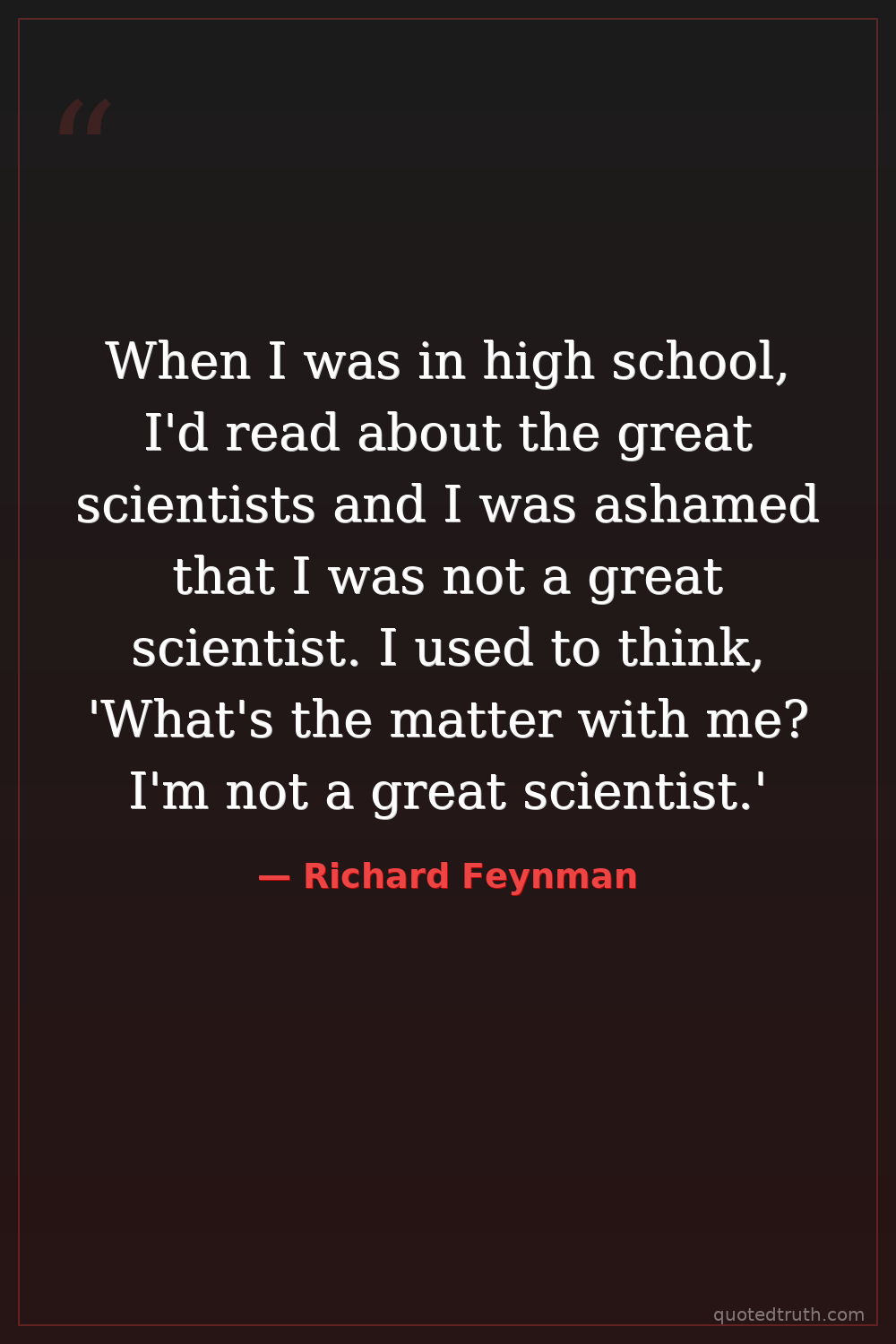
A candid admission of youthful self-doubt: measuring yourself against legends breeds shame rather than inspiration. The speaker recognizes that idolizing greatness can paradoxically make you feel inadequate rather than motivated, trapping you in comparison instead of curiosity-driven learning.
Relevance to Richard Feynman
Feynman became one of the 20th century's greatest physicists, winning the 1965 Nobel Prize for quantum electrodynamics. This early insecurity contrasts sharply with his later bongo-playing, bongo-playing, irreverent persona. His eventual breakthrough was embracing playful curiosity over self-comparison, a lesson he actively taught students throughout his career.
The era
Mid-20th century America elevated scientists like Einstein to near-mythic status, especially post-Manhattan Project. Young science students absorbed hagiographic biographies that portrayed geniuses as born, not made. This culture of hero-worship created impossible benchmarks, making normal intellectual development feel like failure rather than the ordinary path to discovery.
AI-generated insights based on extensive research and information for context. Factual errors? Email [email protected].