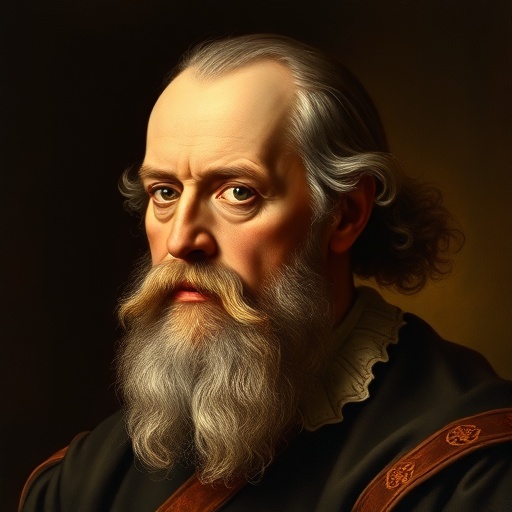
Galileo Galilei — "The universe is an immense, eternal, and infinite work, which can be understood …"
The universe is an immense, eternal, and infinite work, which can be understood only by the one who created it.
The universe is an immense, eternal, and infinite work, which can be understood only by the one who created it.
Click any product to generate a realistic preview. Up to 3 at a time.
* Initial load can take up to 90 seconds — revising the preview in another color is nearly instant.
"It is not necessary to examine all the arguments against a position, but only the strongest."
"You cannot teach a man anything; you can only help him find it within himself."
"It is necessary to examine the actual structure of the universe, and not to cling to old ideas."
"To command the sun and moon, God must have given them motion."
"I cannot but be astonished that Sarsi should persist in trying to prove by means of witnesses something that I may see for myself at any time by means of experiment. Witnesses are examined in doubtful…"
Found in 1 providers: grok
1 source checked
The universe is so vast, ancient, and boundless that no human mind can fully comprehend it. Only the intelligence that designed and built it possesses complete understanding. Humans can observe, measure, and theorize, but total knowledge remains beyond our reach. It is a statement of intellectual humility — recognizing that wonder and mystery are permanent features of existence, not problems to be solved.
Galileo spent his life pushing the boundaries of human knowledge through telescopic observation, discovering Jupiter's moons and defending heliocentrism. Yet even as he expanded science's reach, he recognized its limits. Condemned by the Inquisition for challenging Church cosmology, Galileo understood firsthand how partial human understanding could be weaponized. This quote reflects his reverence for creation's complexity alongside his scientific courage.
The early modern period saw science challenging centuries of Church-sanctioned cosmology. Galileo lived through the Scientific Revolution, when Copernicus and Kepler had already unsettled Earth's central position. The Inquisition actively punished heretical cosmological claims. Asserting the universe's infinite incomprehensibility walked a careful line — honoring divine creation while affirming that human inquiry, though limited, remained legitimate and necessary pursuit.
AI-generated insights based on extensive research and information for context. Factual errors? Email [email protected].
Your cart is empty