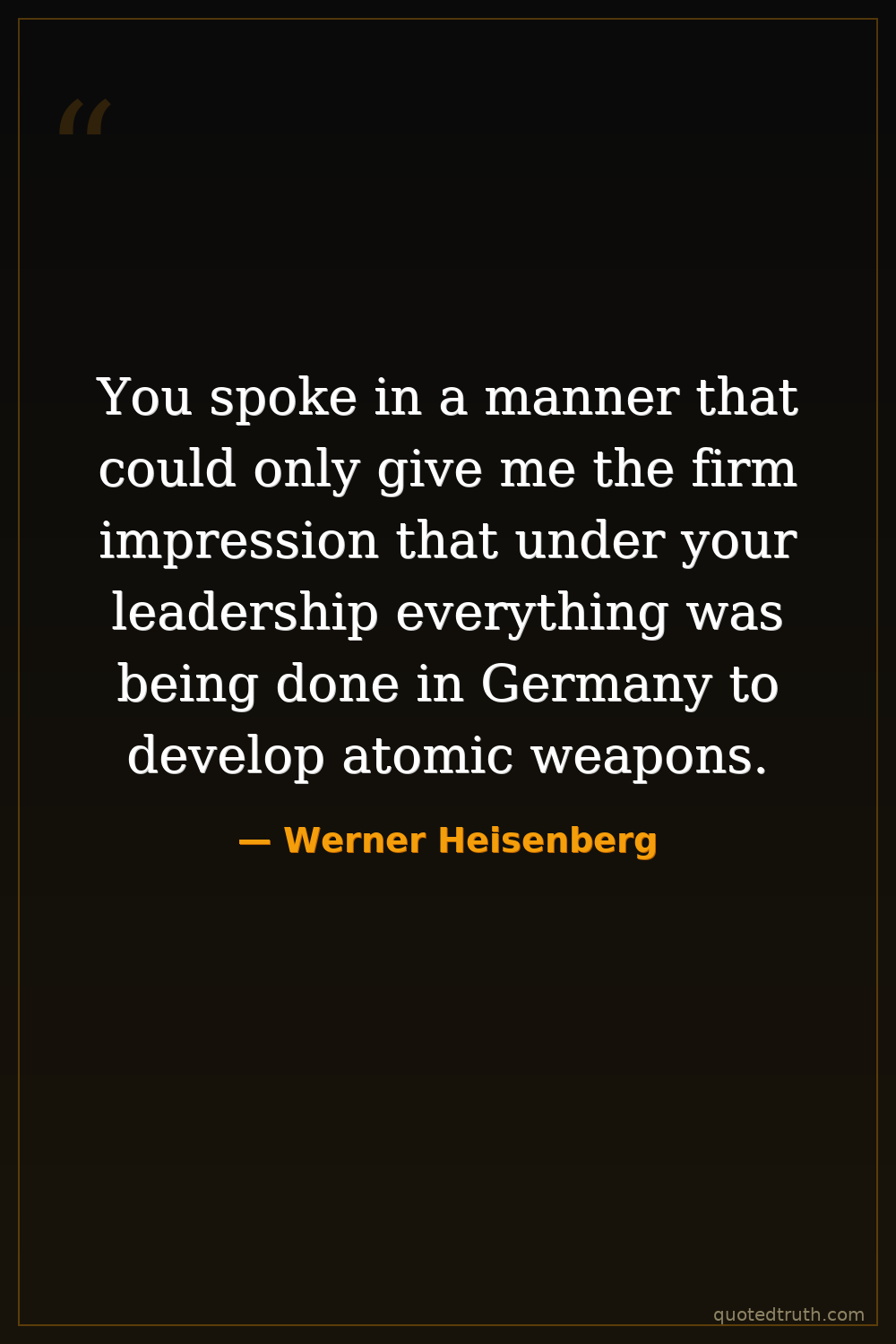
What it means
Heisenberg is recounting a conversation where his counterpart's words left him convinced that the other side was fully committed to building atomic bombs. He's explaining why he walked away believing a weapons program was actively underway, based not on explicit admission but on the tone and implications of what was said. It captures how impressions form from indirect signals during high-stakes discussions about dangerous technology.
Relevance to Werner Heisenberg
Heisenberg led Nazi Germany's nuclear research during WWII and met Niels Bohr in Copenhagen in 1941, a meeting that ruptured their friendship. This line echoes Bohr's recollection of that encounter. As the physicist who discovered the uncertainty principle, Heisenberg spent postwar decades insisting he'd deliberately slowed the German bomb effort, making his exact words during that meeting historically contested and personally defining.
The era
The quote belongs to the 1941 wartime moment when Allied and Axis scientists were racing toward fission weapons. Bohr fled occupied Denmark to join the Manhattan Project; Germany's Uranverein was probing reactor physics. Postwar, the Farm Hall transcripts and Bohr's unsent letters reopened the debate. The era made every scientist's loyalty, intention, and memory a matter of geopolitical weight, with physics entangled in questions of complicity and conscience.
AI-generated insights based on extensive research and information for context. Factual errors? Email [email protected].