Werner Heisenberg — "The human mind cannot be content with a description of phenomena; it wants to un…"
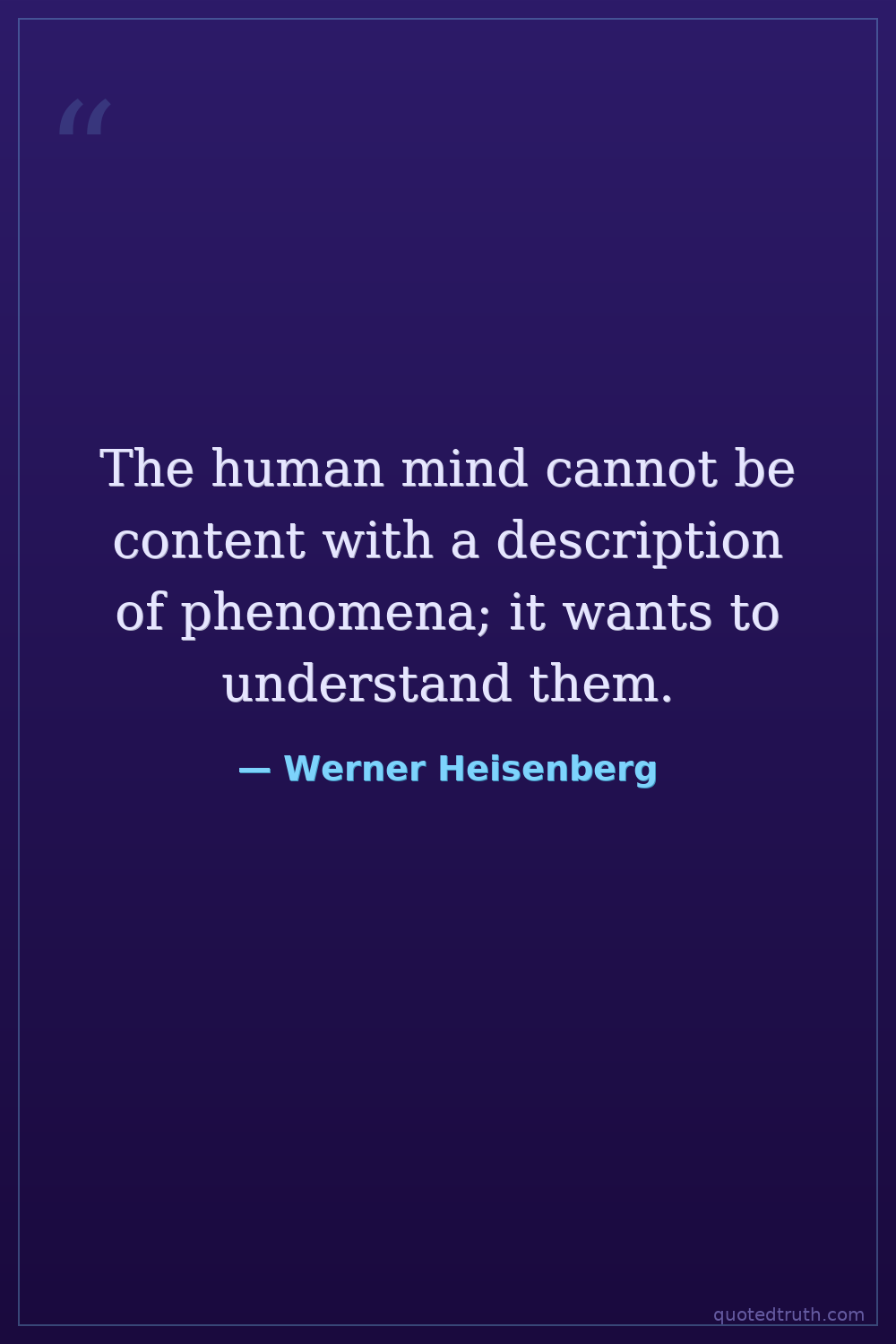
The human mind cannot be content with a description of phenomena; it wants to understand them.
The human mind cannot be content with a description of phenomena; it wants to understand them.
Click any product to generate a realistic preview. Up to 3 at a time.
* Initial load can take up to 90 seconds — revising the preview in another color is nearly instant.
"We wouldn't have had the moral courage to recommend to the government in the spring of 1942 that they should employ 120,000 men just for building the thing up."
"An expert is someone who knows some of the worst mistakes that can be made in his subject and how to avoid them."
"I don't believe a word of the whole thing they must have spent the whole of their £500. million in separating isotopes. and then it's possible."
"You spoke in a manner that could only give me the firm impression that under your leadership everything was being done in Germany to develop atomic weapons."
"We have to remember that what we observe is not nature in itself but nature exposed to our method of questioning."
Found in 1 providers: grok
1 source checked
People aren't satisfied just cataloging what happens in the world. Simply listing observations or describing events isn't enough for us. We have a deeper drive to figure out why things happen, what underlying rules govern them, and how everything fits together. Raw data and surface-level accounts leave us restless. Real intellectual satisfaction comes only when we grasp the mechanisms, causes, and principles beneath appearances, turning scattered facts into genuine comprehension.
Heisenberg lived this tension. His 1925 matrix mechanics started as pure mathematical description of atomic spectra, but he pushed further, wrestling with what quantum equations actually meant. His uncertainty principle wasn't just a formula; it was an attempt to understand why nature resists classical pictures. He debated Bohr and Einstein for decades about interpretation, refusing to accept 'shut up and calculate.' For him, physics demanded philosophical understanding, not just predictive machinery.
Heisenberg worked during quantum theory's birth (1920s-1930s), when physicists confronted phenomena that defied intuition: wave-particle duality, probabilistic outcomes, observer effects. Einstein's 'God does not play dice' captured the crisis. The Copenhagen interpretation, Solvay Conferences, and Bohr-Einstein debates all grappled with whether physics should merely predict or truly explain. This era also saw logical positivism urging scientists to abandon metaphysics, making Heisenberg's insistence on understanding a philosophical stance, not just a scientific preference.
AI-generated insights based on extensive research and information for context. Factual errors? Email [email protected].
Your cart is empty