Siddhartha Gautama (Buddha) — "If you find no one to support you on the spiritual path, walk alone. There is no…"
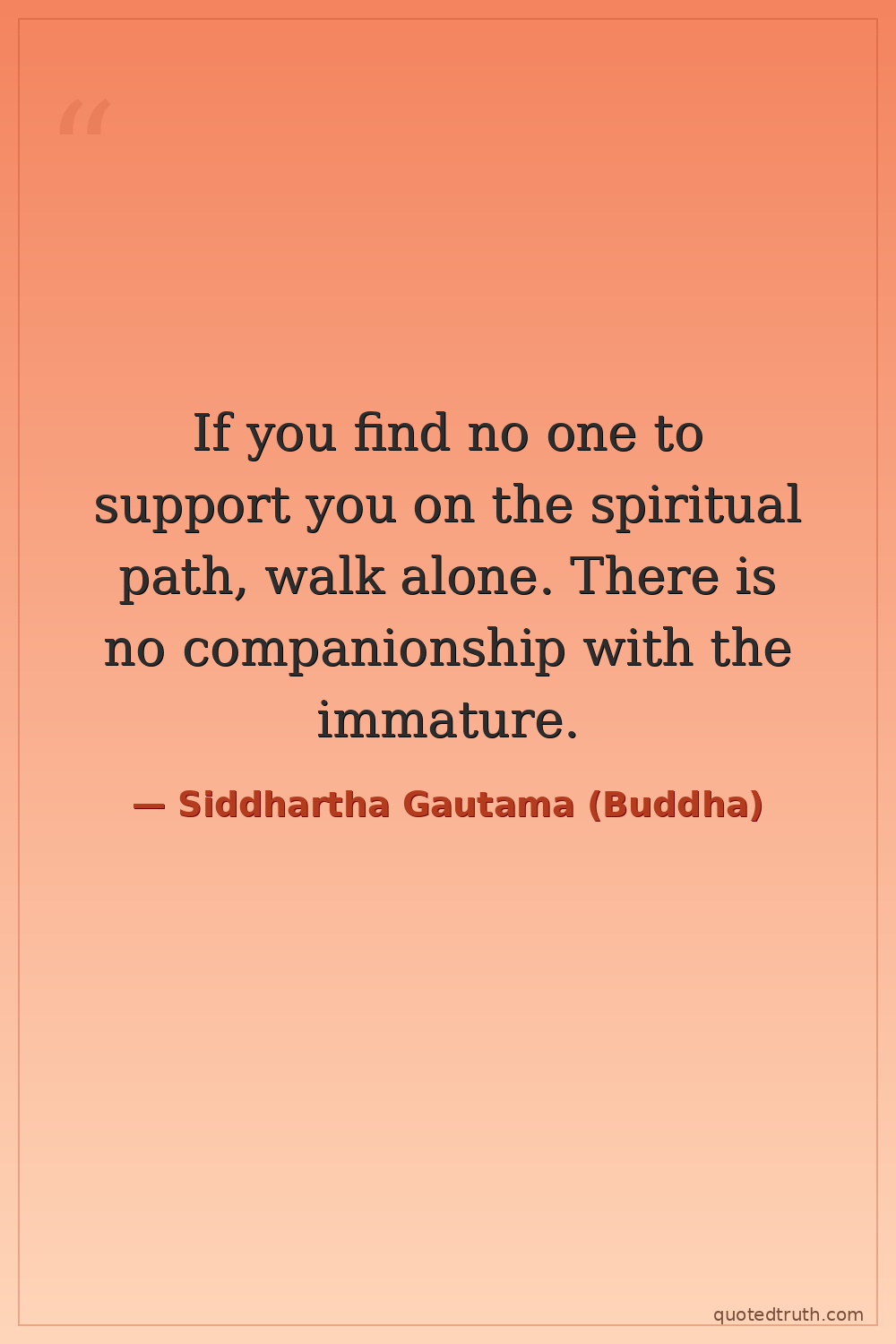
If you find no one to support you on the spiritual path, walk alone. There is no companionship with the immature.
If you find no one to support you on the spiritual path, walk alone. There is no companionship with the immature.
Click any product to generate a realistic preview. Up to 3 at a time.
* Initial load can take up to 90 seconds — revising the preview in another color is nearly instant.
"Let them not do the slightest thing that the wise would later reprove."
"A jug fills drop by drop."
"Do not pursue the past. Do not lose yourself in the future. The past no longer is. The future has not yet come. Looking deeply at life as it is in the very here and now, the practitioner dwells in sta…"
"When watching after yourself, you watch after others. When watching after others, you watch after yourself."
"It is a man's own mind, not his enemy or foe, that lures him to evil ways."
Found in 1 providers: grok
1 source checked
Genuine growth sometimes requires solitude. If you cannot find peers who share your commitment to wisdom, discipline, and inner development, it is better to travel the path by yourself than to accept the company of those who are spiritually careless or foolish. Bad companions drag you backward, while walking alone at least keeps your progress intact. Solitude is preferable to corrupting company when the goal is serious self-transformation.
Siddhartha literally walked alone after leaving his palace, his wife, and his royal inheritance at age 29 to seek liberation. He studied under teachers, surpassed them, then meditated solo under the Bodhi tree until awakening. Though he later founded the Sangha, he consistently taught that an unworthy companion is worse than none. This saying, preserved in the Dhammapada, mirrors his own biography of renouncing comfortable but spiritually empty society.
In 5th-century BCE northern India, the Shramana movement produced wandering ascetics who rejected Vedic ritual orthodoxy and the rigid caste-bound householder life. Seekers routinely abandoned families to join forest hermitages, yet many groups were doctrinally shallow or ego-driven. Against this crowded spiritual marketplace of Jains, Ajivikas, and competing gurus, the Buddha's advice to walk alone rather than settle for immature company was a pointed warning about the era's spiritual tourism.
AI-generated insights based on extensive research and information for context. Factual errors? Email [email protected].
Your cart is empty