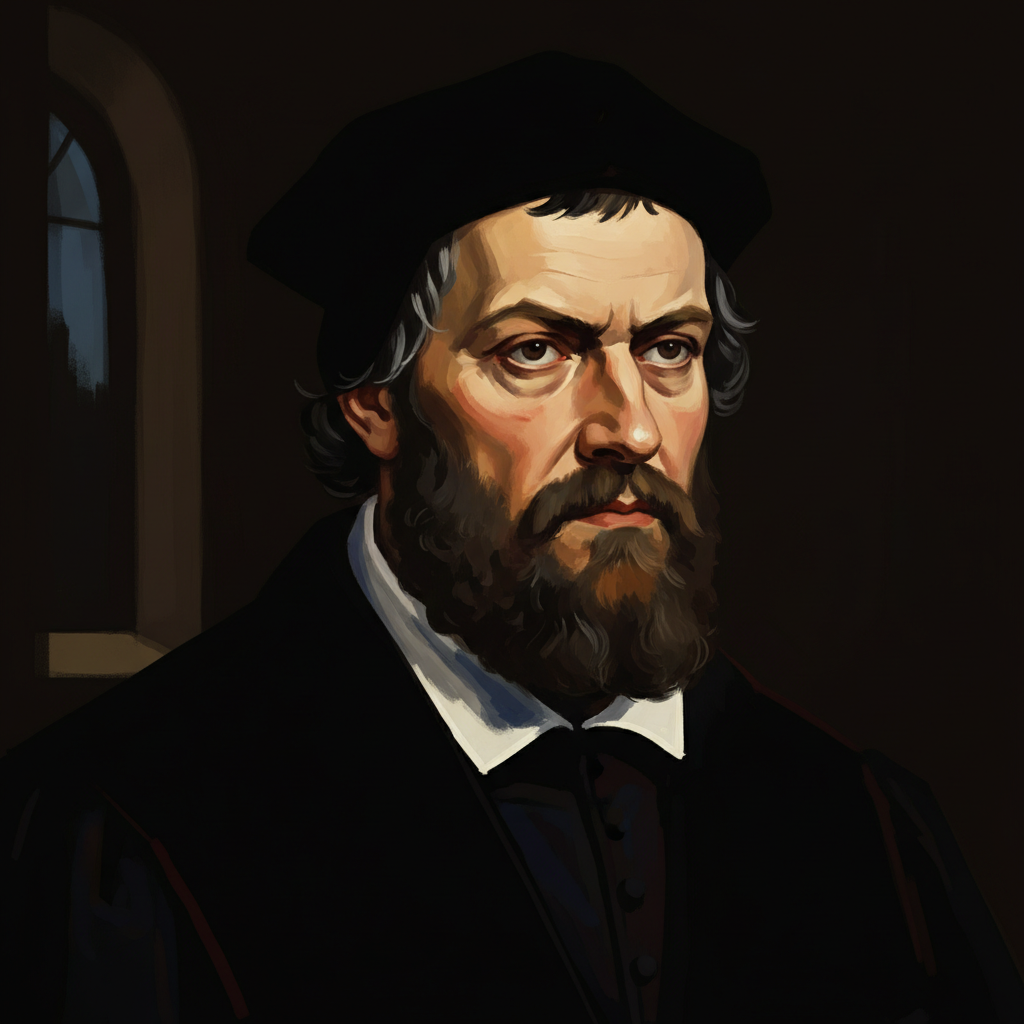
Martin Luther — "The Holy Spirit unveiled the Scriptures for me in this tower at the lavatory."
The Holy Spirit unveiled the Scriptures for me in this tower at the lavatory.
The Holy Spirit unveiled the Scriptures for me in this tower at the lavatory.
Click any product to generate a realistic preview. Up to 3 at a time.
* Initial load can take up to 90 seconds — revising the preview in another color is nearly instant.
"Mankind has a free will; but it is free to milk cows and to build houses, nothing more."
"I am rough, boorish, stormy, and altogether warlike. I am born to fight with devils and factions, and to lay waste the kingdom of Satan."
"I have been so busy with writing that I have not had time to pray."
"The book of Esther I toss into the Elbe. I am such an enemy to the book of Esther that I wish it did not exist, for it Judaizes too much and has in it a great deal of heathenish foolishness."
"The hair is the finest ornament women have."
German theologian whose 95 Theses (1517) launched the Protestant Reformation and broke the Catholic Church's monopoly on Western Christianity. Closely associated with Philipp Melanchthon (Lutheran systematizer) and John Calvin (later Reformer who built on Luther's break). For an intellectual contrast, see Pope Leo X, Renaissance pope (1513-1521) — Leo X's indulgence sales triggered Luther's break and Leo excommunicated him in 1521 — Luther's entire Reformation is structured as a direct answer to the indulgence-funded Vatican Leo represented.
Reported as said, referring to a spiritual revelation.
Date: Undated, from 'Table Talk'
GeneralFound in 1 providers: gemini
1 source checked
Luther is claiming that his breakthrough understanding of the Bible came to him through divine inspiration while he was sitting on the toilet in a tower room. He credits the Holy Spirit, not his own scholarship, for revealing the true meaning of Scripture. The blunt mention of the lavatory underscores that spiritual insight can strike in the most ordinary, even undignified, physical settings rather than in formal sacred spaces.
Luther lived and worked in the tower of the Augustinian monastery at Wittenberg, where tradition places his famous Turmerlebnis, or tower experience, the moment he grasped justification by faith alone. He was famously earthy in speech, frequently invoking bodily functions, and suffered chronic constipation, so time at the latrine was real study time. Crediting the Spirit fits his doctrine that Scripture interprets itself to the believer, bypassing papal authority.
In the early sixteenth century, biblical interpretation was monopolized by the Catholic Church, which held that only ordained clergy and Church tradition could unlock Scripture's meaning. Luther's 1517 theses and subsequent writings shattered that monopoly, fueled by Gutenberg's press, rising literacy, and German resentment of Rome's indulgence trade. Claiming personal, Spirit-given insight, even from a toilet, was a radical democratizing move that helped ignite the Reformation and permanently split Western Christendom.
AI-generated insights based on extensive research and information for context. Factual errors? Email [email protected].
Your cart is empty