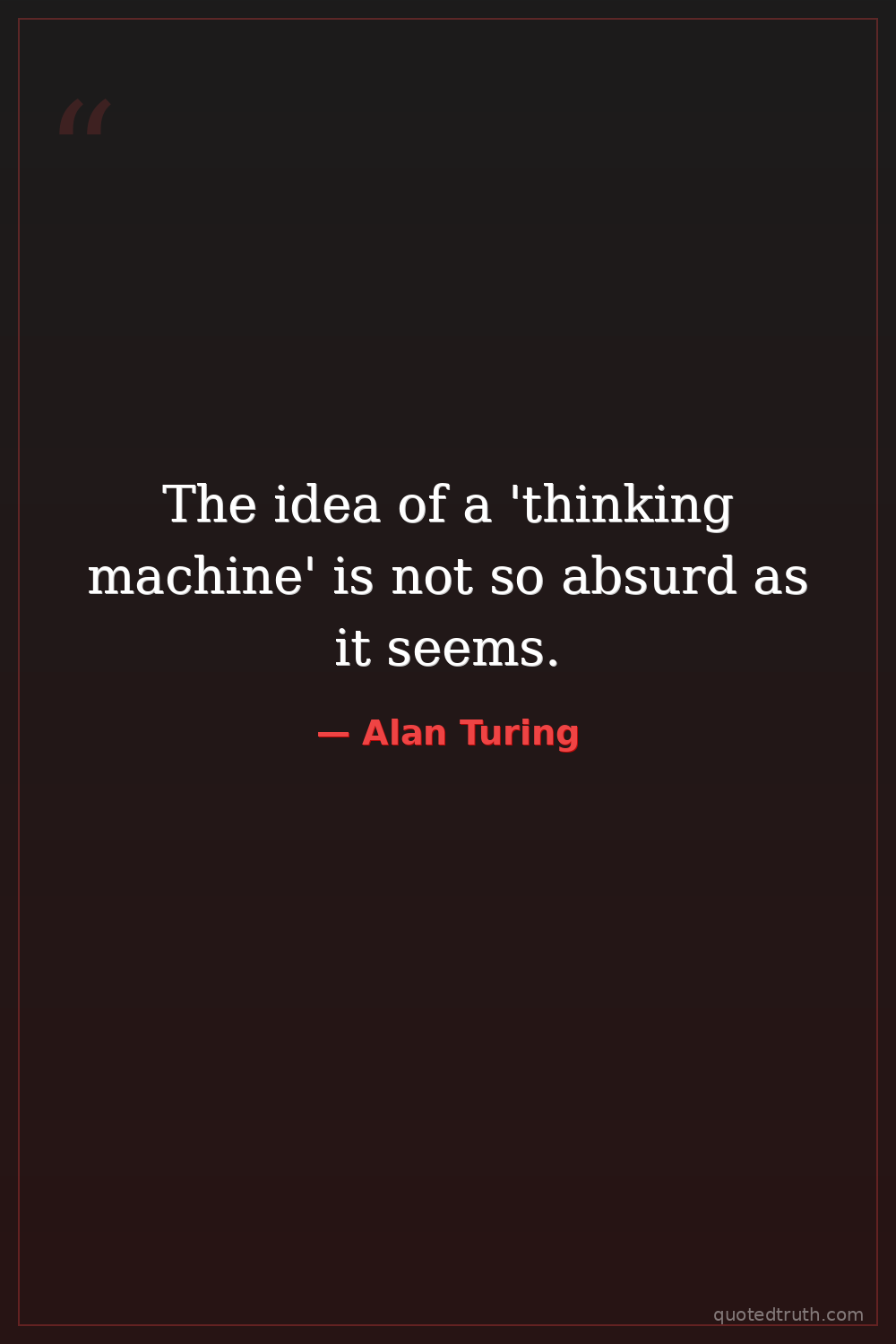
Alan Turing — "The idea of a 'thinking machine' is not so absurd as it seems."
The idea of a 'thinking machine' is not so absurd as it seems.
The idea of a 'thinking machine' is not so absurd as it seems.
Click any product to generate a realistic preview. Up to 3 at a time.
* Initial load can take up to 90 seconds — revising the preview in another color is nearly instant.
"The works and customs of mankind do not seem to be very suitable material to which to apply scientific induction."
"I've now got myself into the kind of trouble that I have always considered to be quite a possibility for me, though I have usually rated it at about 10:1 against."
"The imitation game is a test of intelligence, not a test of consciousness."
"The future belongs to those who can master the art of information."
"I like to think the brain is a kind of pudding, but not a Christmas pudding."
Found in 1 providers: grok
1 source checked
Machines capable of genuine thought aren't an absurd fantasy — cognition isn't some mystical property exclusive to humans. Intelligence might be a process that can be replicated mechanically or computationally. Turing is pushing back against reflexive dismissal, arguing that if we can define what thinking is, we can ask seriously whether a machine could do it. The burden of proof falls on the skeptic, not the believer.
Turing's 1950 paper 'Computing Machinery and Intelligence' opened with 'Can machines think?' — the same provocation restated here. His Bombe machine at Bletchley cracked Nazi Enigma codes, proving mechanical processes could solve problems thought to require human ingenuity. He designed the Turing Test as a concrete measure of machine cognition. His entire scientific identity was built on treating intelligence as a computable, not mystical, phenomenon.
In the early 1950s, electronic computers were new and widely seen as glorified calculators. Mainstream philosophy held that thought required consciousness, a soul, or biological substrate — machines were tools, not minds. Turing wrote directly against this consensus. Post-WWII technological optimism coexisted with deep skepticism about machine agency. The Cold War also sharpened interest in what automated intelligence could achieve for national security and scientific dominance.
AI-generated insights based on extensive research and information for context. Factual errors? Email [email protected].
Your cart is empty