Alexander Fleming — "The scientist has to be a perpetual child, always asking 'Why?'"
The scientist has to be a perpetual child, always asking 'Why?'
The scientist has to be a perpetual child, always asking 'Why?'
Click any product to generate a realistic preview. Up to 3 at a time.
* Initial load can take up to 90 seconds — revising the preview in another color is nearly instant.
"I have always been interested in the fight against disease."
"The unprepared mind cannot see the outstretched hand of opportunity."
"The discovery of penicillin was a series of lucky accidents."
"I often wonder how many other useful molds have been thrown away by bacteriologists."
"It is remarkable how easily the public can be misled by sensational statements."
Found in 1 providers: grok
1 source checked
Real scientific work depends on never losing the curiosity kids have before adults teach them to stop asking. A scientist must keep questioning what everyone else takes for granted, refusing to accept 'that's just how it is' as an answer. The moment you treat the world as already explained, you stop being able to discover anything new. Wonder, not credentials, is the actual engine of research.
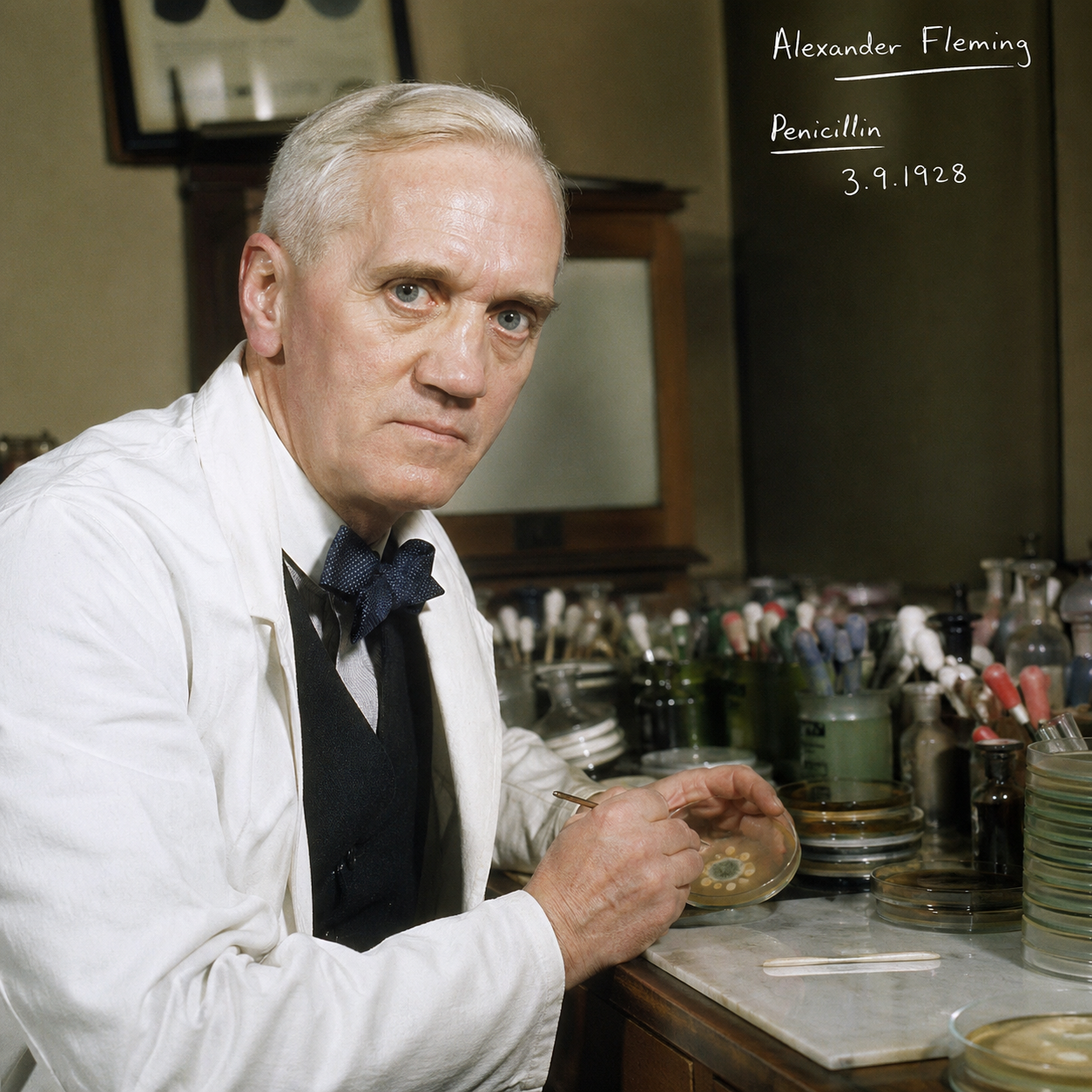
Fleming embodied this. In 1928 he noticed a contaminated petri dish where mold had killed surrounding Staphylococcus colonies, something most bacteriologists would have tossed out as a ruined experiment. Instead he asked why, isolated Penicillium notatum, and opened the antibiotic era. His earlier discovery of lysozyme came the same way, from a curious cold-drip onto a culture. He credited untidiness and questions, not planning, for the breakthroughs that won him the 1945 Nobel.
Fleming worked through an era when infection was the leading killer: World War I trenches he served in saw soldiers die routinely from sepsis, pneumonia, and gangrene that doctors could not treat. The 1920s–40s scientific establishment prized rigorous protocol and dismissed accidents as failure. Yet penicillin, mass-produced in time for D-Day in 1944, transformed surgery, childbirth, and the Second World War's survival rates, validating the childlike question over institutional certainty.
AI-generated insights based on extensive research and information for context. Factual errors? Email [email protected].
Your cart is empty