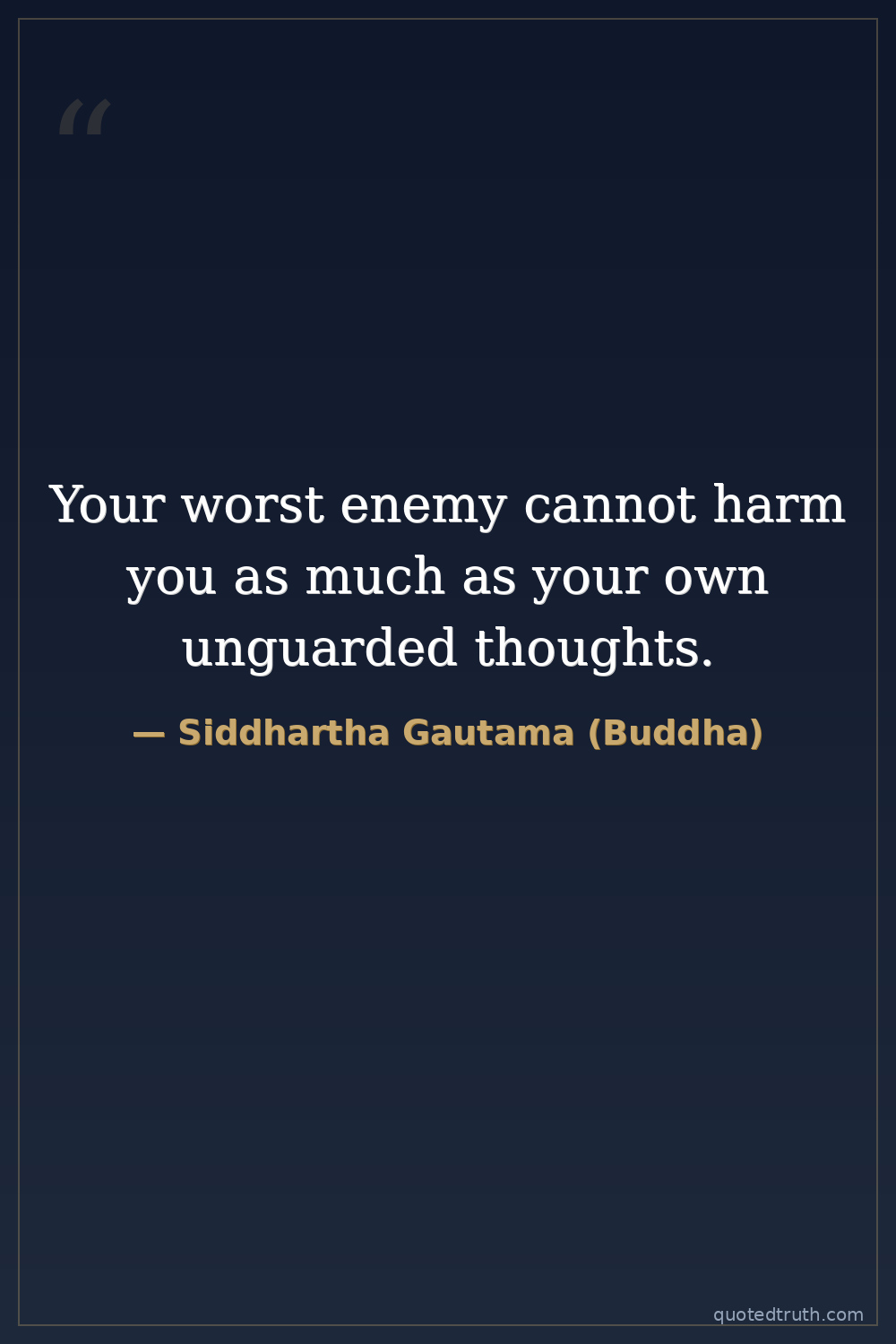
Siddhartha Gautama (Buddha) — "Your worst enemy cannot harm you as much as your own unguarded thoughts."
Your worst enemy cannot harm you as much as your own unguarded thoughts.
Your worst enemy cannot harm you as much as your own unguarded thoughts.
Click any product to generate a realistic preview. Up to 3 at a time.
* Initial load can take up to 90 seconds — revising the preview in another color is nearly instant.
"Peace comes from within. Do not seek it without."
"When you realize how perfect everything is, you will tilt your head back and laugh at the sky."
"It is in the nature of things that joy arises in a person free from remorse."
"Should a seeker not find a friend, wiser or better than himself, let him rather walk alone; there is no fellowship with fools."
"The tongue is a sharp knife... It kills without drawing blood."
Found in 2 providers: grok,gemini
2 sources checked
The damage caused by external enemies is limited compared to the harm you inflict on yourself through undisciplined thinking. Anger, jealousy, resentment, fear, and self-criticism running unchecked in your mind cause suffering that no outside attacker could match. An enemy can hurt your body or circumstances briefly, but toxic thoughts corrode your peace, decisions, and wellbeing every hour of every day. Mental discipline protects you more than any armor.
Buddha built his entire teaching around the mind as the source of suffering and liberation. After abandoning princely life and years of extreme asceticism, he achieved enlightenment through meditation under the Bodhi tree, discovering that craving and untrained thought patterns generate dukkha. His Noble Eightfold Path includes Right Mindfulness and Right Concentration specifically to guard the mind. This saying distills his central insight: the battlefield is internal, not external.
In 5th-6th century BCE northern India, the Vedic sacrificial religion dominated, emphasizing external rituals, caste duty, and appeasing gods through priests. Buddha's era saw the Shramana movement challenge this, with wandering ascetics seeking liberation through personal practice rather than ceremony. Political violence between kingdoms like Magadha and Kosala was common. Teaching that self-mastery mattered more than enemies or rituals was radical, shifting spiritual authority from Brahmin priests to individual mental cultivation.
AI-generated insights based on extensive research and information for context. Factual errors? Email [email protected].
Your cart is empty