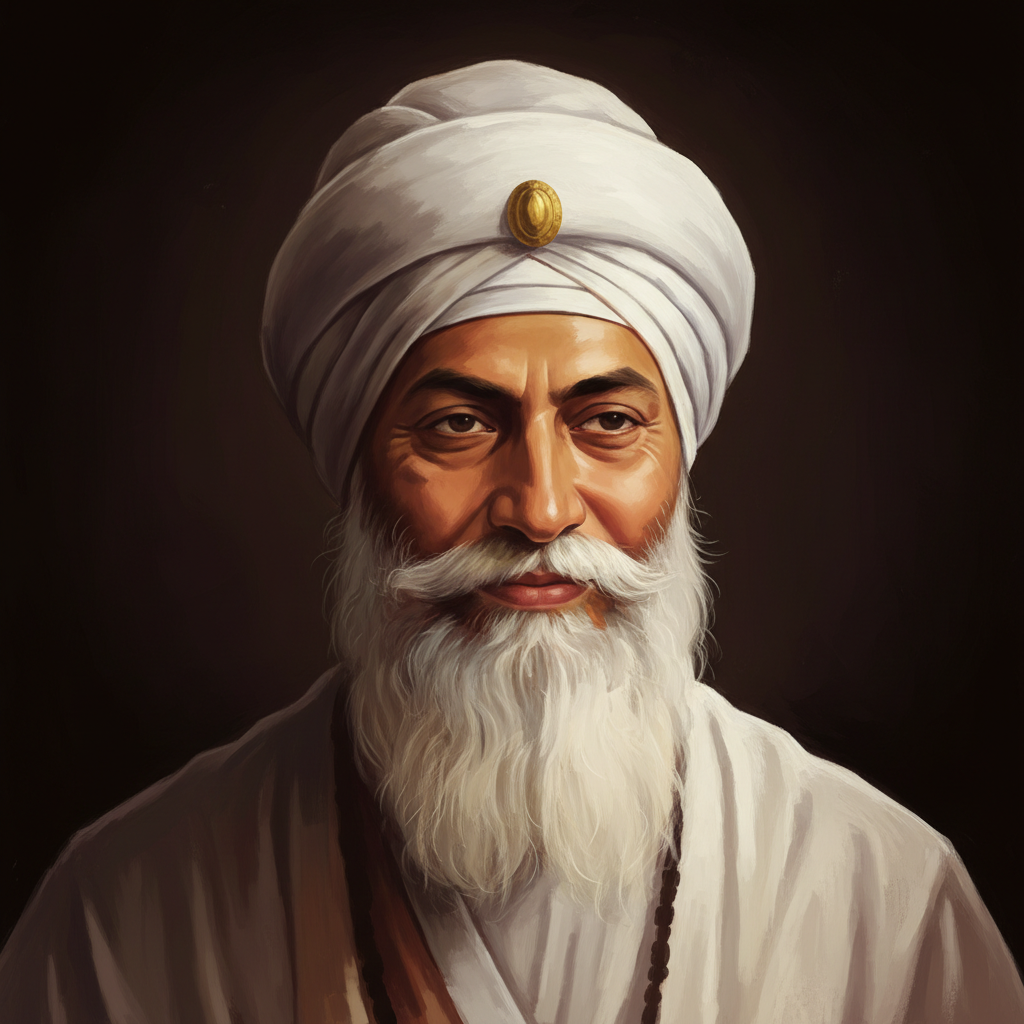
Guru Nanak — "He who recognizes the One Lord through all, is a true Brahmin."
He who recognizes the One Lord through all, is a true Brahmin.
He who recognizes the One Lord through all, is a true Brahmin.
Click any product to generate a realistic preview. Up to 3 at a time.
* Initial load can take up to 90 seconds — revising the preview in another color is nearly instant.
"Be the wisdom your support. Be the compassion your guide and listen to the Divine Music that beats in every heart."
"The blessings of God are for all, without discrimination."
"The whole creation is His temple."
"Make compassion the cotton, contentment the thread, modesty the knot and truth the twist. This is the sacred thread of the soul; if you have it, then go ahead and put it on me."
"Without virtues, there is no devotion."
Founder of Sikhism and the first of the Ten Sikh Gurus, whose teachings of one universal God and rejection of caste shaped Punjab. Closely associated with Kabir (mystical poet whose verses appear in the Sikh Guru Granth Sahib). For an intellectual contrast, see Brahmanical orthodoxy, the Hindu caste-and-ritual establishment of his era — Sikhism was founded as a deliberate alternative to both Hindu ritual hierarchy and Islamic exclusivism — Nanak's universalism was a structural rejection of caste and priestly mediation.
Found in 1 providers: gemini
1 source checked
Real spiritual authority does not come from inherited caste or ritual purity, but from genuinely seeing one divine reality present in every person and thing. The label 'Brahmin' belongs to whoever actually perceives that underlying oneness, not to whoever was born into a priestly family or memorized the right scriptures. In modern terms: your standing before the divine is measured by clarity of vision and lived recognition, not by pedigree, title, or performed religiosity.
Guru Nanak rejected caste hierarchy as the central injustice of his society and built Sikhism on the conviction that one Creator (Ik Onkar) pervades all existence. He famously declared 'there is no Hindu, there is no Muslim,' ate and traveled across caste and religious lines, and founded the langar communal kitchen where everyone sits as equals. Redefining 'Brahmin' by inner realization rather than birth is a direct expression of his lifelong teaching mission across South Asia.
Guru Nanak (1469–1539) lived in Punjab during early Mughal expansion, when Hindu caste rigidity and Muslim political dominance shaped daily life. Brahmins controlled ritual access, untouchables were excluded from temples and wells, and Hindu-Muslim tension was sharpened by Babur's 1526 invasion, which Nanak witnessed and lamented. The Bhakti and Sufi movements were already challenging ritualism with devotion-based equality, and Nanak's redefinition of spiritual rank by inner realization landed squarely in that reformist current.
AI-generated insights based on extensive research and information for context. Factual errors? Email [email protected].
Your cart is empty