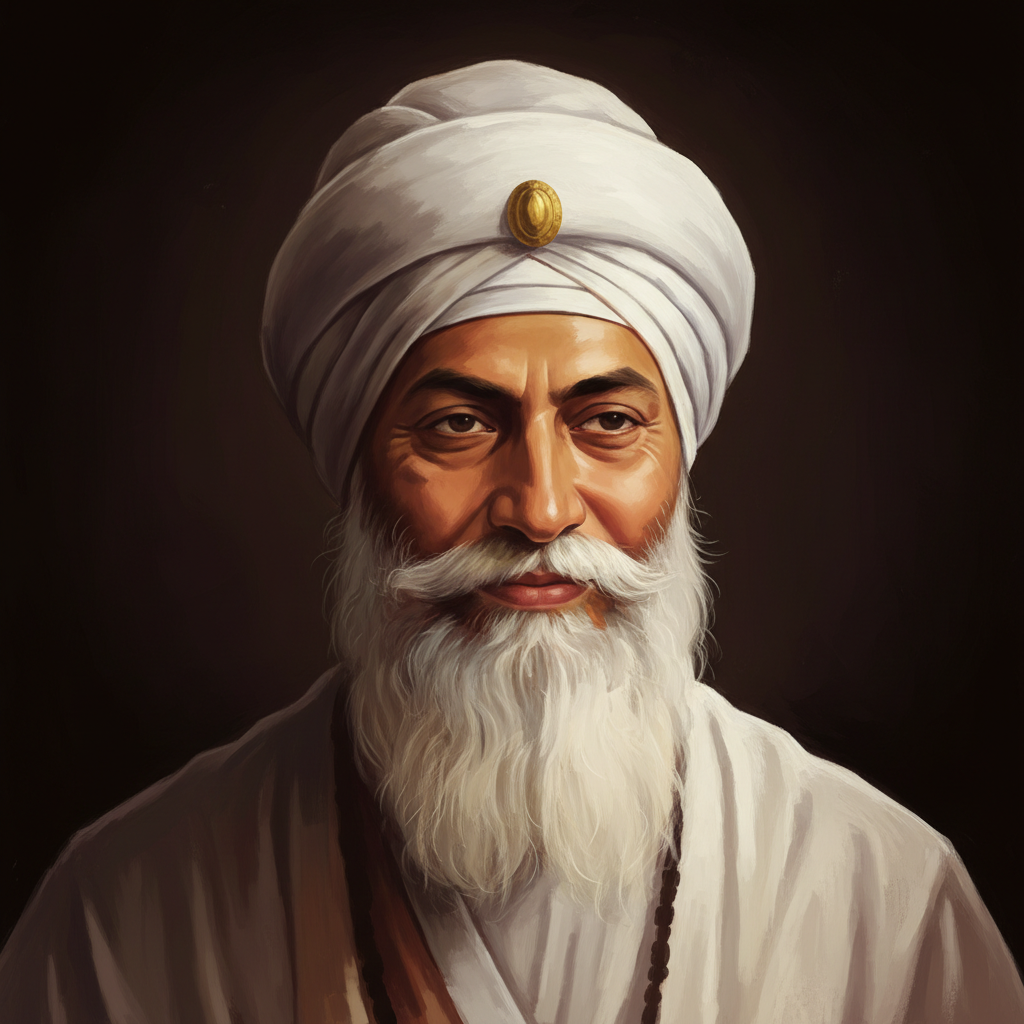
Guru Nanak — "The Commander issues the order, and the soldiers array themselves accordingly. T…"
The Commander issues the order, and the soldiers array themselves accordingly. They cannot see the Commander, but they must obey His Order.
The Commander issues the order, and the soldiers array themselves accordingly. They cannot see the Commander, but they must obey His Order.
Click any product to generate a realistic preview. Up to 3 at a time.
* Initial load can take up to 90 seconds — revising the preview in another color is nearly instant.
"The mind is the elephant, and the body is the rider."
"Guru Nanak taught that depriving others of their rights is a serious moral offense."
"Why call her bad from whom are born kings?"
"Make compassion the cotton, contentment the thread, modesty the knot and truth the twist. This is the sacred thread of the soul; if you have it, then go ahead and put it on me."
"He who serves the Guru, he alone finds peace."
Founder of Sikhism and the first of the Ten Sikh Gurus, whose teachings of one universal God and rejection of caste shaped Punjab. Closely associated with Kabir (mystical poet whose verses appear in the Sikh Guru Granth Sahib). For an intellectual contrast, see Brahmanical orthodoxy, the Hindu caste-and-ritual establishment of his era — Sikhism was founded as a deliberate alternative to both Hindu ritual hierarchy and Islamic exclusivism — Nanak's universalism was a structural rejection of caste and priestly mediation.
From a Shabad, describing the divine order of the universe in militaristic terms.
Date: circa 1500
War & ConflictFound in 1 providers: deepseek
1 source checked
A disciplined army follows commands from a leader they never actually see, trusting the chain of command absolutely. The quote compares this to how the universe operates: an unseen force sets everything in motion, and all existence falls into place according to that instruction. Obedience doesn't require visual proof of the one giving orders; it requires recognition that a higher command is already structuring reality, whether you perceive it directly or not.
Guru Nanak founded Sikhism around the concept of Hukam, the divine command or cosmic order that governs everything. He taught that God is formless and invisible yet present in all creation, and that humans must align with this unseen will rather than demand physical proof. His own life, marked by long journeys preaching surrender to one universal Creator, embodied this trust in an unseen Commander over ritual-based religious authority.
Guru Nanak lived in 15th-16th century Punjab under the Delhi Sultanate and early Mughal rule, a region torn between Hindu caste orthodoxy and Islamic theological dominance. Armies, sultans, and emperors demanded visible obedience while clerics and Brahmins gatekept access to the divine. Using military imagery would have resonated immediately with audiences living under conquest and shifting rulers, while redirecting their loyalty from earthly commanders to a single formless Creator transcending religious boundaries.
AI-generated insights based on extensive research and information for context. Factual errors? Email [email protected].
Your cart is empty