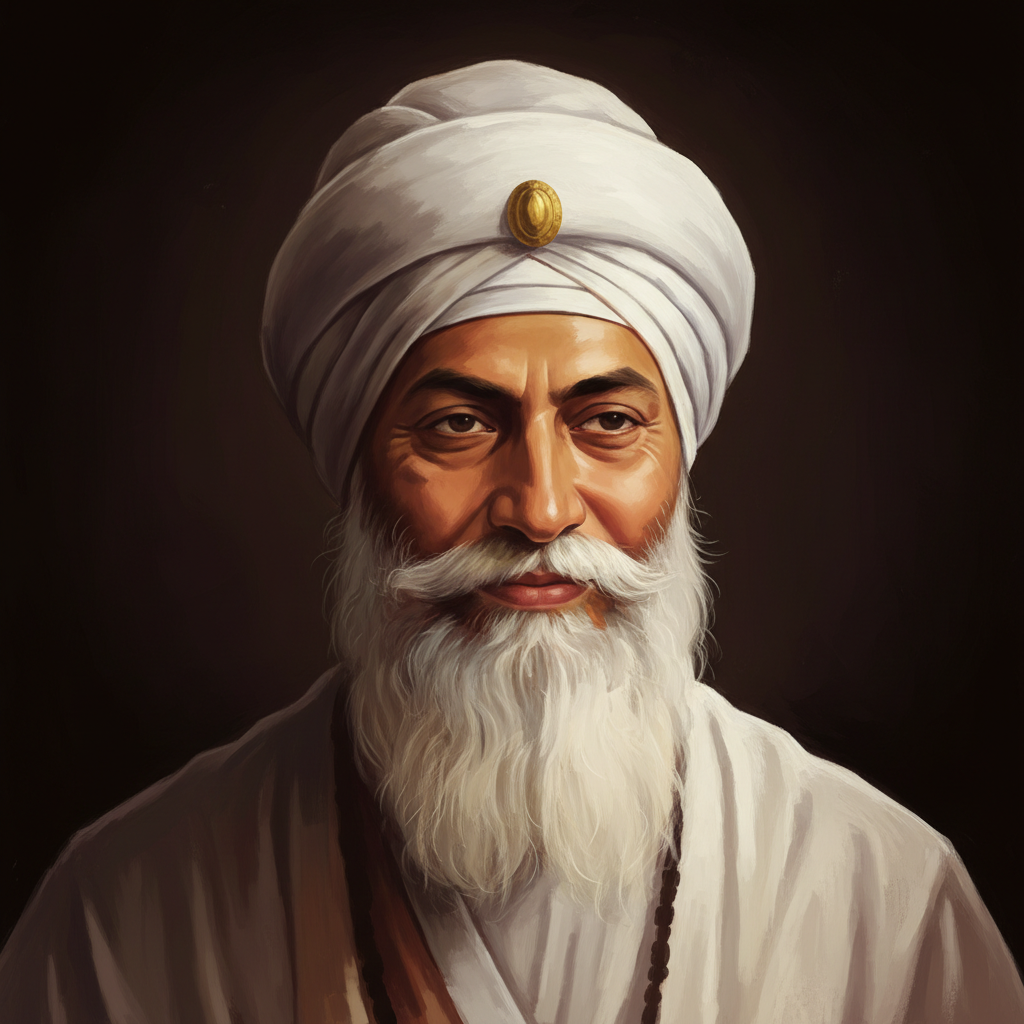
Guru Nanak — "To conquer the mind is to conquer the world."
To conquer the mind is to conquer the world.
To conquer the mind is to conquer the world.
Click any product to generate a realistic preview. Up to 3 at a time.
* Initial load can take up to 90 seconds — revising the preview in another color is nearly instant.
"He alone is a true Yogi who knows the essence of the Self."
"One cannot comprehend Him through the intellect, even if one were to try a hundred thousand times."
"Religion consists not in words; He who looks on all men as equal is religious."
"Live in the world, but remain untouched by it, like a lotus in water."
"Realization of Truth is higher than all else. Higher still is truthful living."
Founder of Sikhism and the first of the Ten Sikh Gurus, whose teachings of one universal God and rejection of caste shaped Punjab. Closely associated with Kabir (mystical poet whose verses appear in the Sikh Guru Granth Sahib). For an intellectual contrast, see Brahmanical orthodoxy, the Hindu caste-and-ritual establishment of his era — Sikhism was founded as a deliberate alternative to both Hindu ritual hierarchy and Islamic exclusivism — Nanak's universalism was a structural rejection of caste and priestly mediation.
Found in 2 providers: gemini,grok
2 sources checked
Your biggest battles are internal, not external. The restless thoughts, cravings, fears, and ego inside you shape how you experience everything around you. If you can discipline your own mind, sitting with impulses instead of obeying them, the outside world loses its power to control you. Real mastery is not dominating other people or circumstances; it is governing your own attention, reactions, and desires. Inner command is the foundation of every outer achievement.
Guru Nanak taught that liberation comes through inward devotion, not ritual, caste, or conquest. He built Sikhism around nam simran, meditative remembrance of the divine name, and haumai, the ego self that must be dissolved. As a traveling teacher who walked thousands of miles across South Asia and the Middle East, he consistently urged disciples to turn inward. This saying reflects his conviction that mastering one's own mind, not the external world, is the true spiritual victory.
Nanak lived 1469-1539 in Punjab during the early modern era, a region squeezed between Lodi sultans, the arriving Mughals under Babur, and entrenched Hindu caste hierarchies. Religion was largely performative: temple rituals, pilgrimages, and Islamic orthodoxy competed while ordinary people suffered political violence and social exclusion. Nanak rejected these external forms and preached an accessible interior path open to all castes, genders, and faiths. Emphasizing conquest of the mind was a radical pivot from conquest of territory defining his age.
AI-generated insights based on extensive research and information for context. Factual errors? Email [email protected].
Your cart is empty