What it means
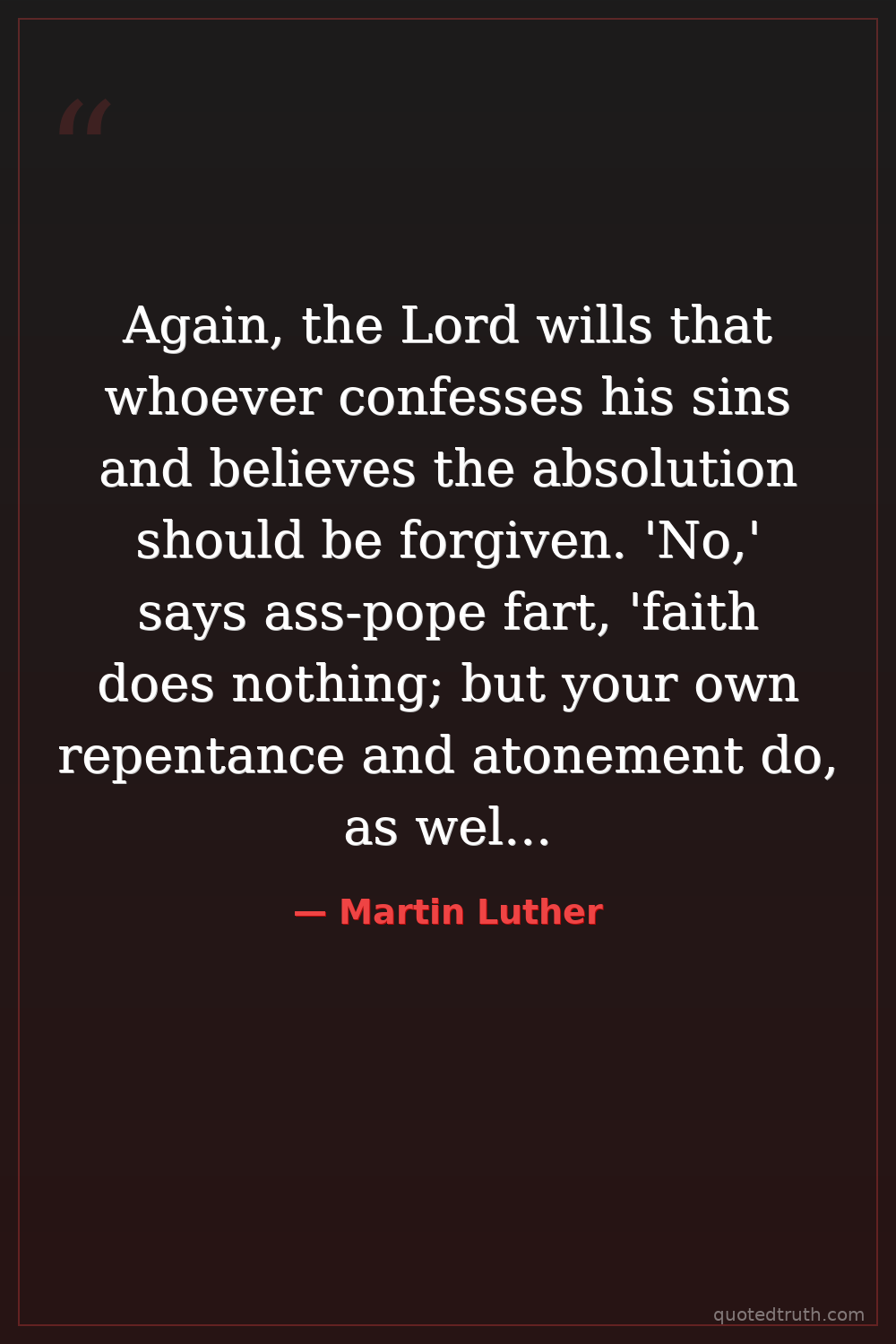
Luther argues that God promises forgiveness to anyone who openly admits their wrongs and trusts the priest's words of pardon. He mocks opponents who claim belief alone isn't enough, insisting instead that sinners must personally feel sorry, make up for the offense, and list every single hidden or forgotten sin from memory. Luther sees that demand as an impossible burden that undermines the simple gospel promise of free forgiveness through faith.
Relevance to Martin Luther
This captures Luther's signature theology of justification by faith alone and his scorched-earth rhetoric against the papacy, whom he literally names 'ass-pope.' A former Augustinian friar tormented by confession's impossible demands, Luther rejected Rome's penance system requiring enumeration of every sin, contrition, and satisfaction. His crude scatological insults toward popes were a trademark, and his insistence that absolution works through faith in Christ's promise defined the Reformation he launched in 1517.
The era
Luther wrote amid the early modern Catholic sacramental system, where annual confession mandated by the Fourth Lateran Council required listing every mortal sin. Indulgences sold by Tetzel in 1517 sparked Luther's 95 Theses. The printing press spread his German pamphlets across a fragmenting Holy Roman Empire. By the 1530s-40s, confessional lines hardened, popes Leo X through Paul III excommunicated reformers, and Luther's increasingly vulgar polemics reflected the bitter, irreversible split tearing Western Christendom apart.
AI-generated insights based on extensive research and information for context. Factual errors? Email [email protected].