Laozi — "When the world has the Tao, the swift horses are used for hauling manure. When t…"
When the world has the Tao, the swift horses are used for hauling manure. When the world is without the Tao, war horses are bred in the suburbs.
When the world has the Tao, the swift horses are used for hauling manure. When the world is without the Tao, war horses are bred in the suburbs.
Click any product to generate a realistic preview. Up to 3 at a time.
* Initial load can take up to 90 seconds — revising the preview in another color is nearly instant.
"Pursue without interfering."
"The sage puts his own person last, and yet it is found in the foremost place; he treats his person as foreign to him, and yet it is preserved."
"The whole world knows that the good is good, and this is how evil arises. The whole world knows that the beautiful is beautiful, and this is how ugliness arises."
"Under heaven all can see beauty as beauty only because there is ugliness. All can know good as good only because there is evil."
"The heaviest thing in the world is a human heart."
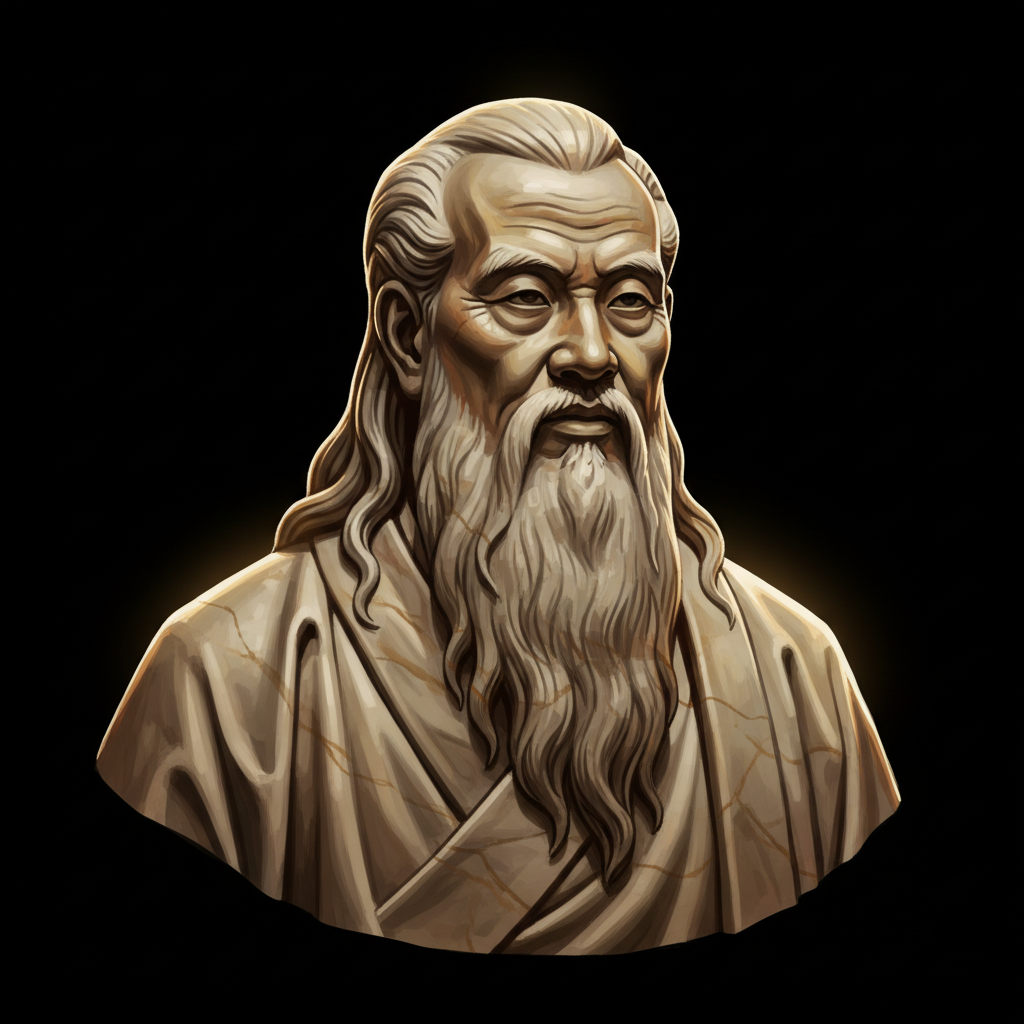
Reputed founder of Taoism and author of the Tao Te Ching, whose wu wei (effortless action) shaped East Asian philosophy. Closely associated with Zhuangzi (later Taoist who extended Laozi's framework). For an intellectual contrast, see Confucius, near-contemporary Chinese sage of social ritual and duty — Confucius systematized social order through ritual and hierarchy; Laozi argued that all such systems were the disease, not the cure — the two founding poles of Chinese moral philosophy.
Found in 1 providers: gemini
1 source checked
When a society is peaceful and well-ordered, its resources and powerful tools get redirected toward productive, humble work like farming. When a society loses its moral compass and falls into conflict, those same resources get weaponized and placed on standby for violence. The quality of a civilization shows in whether its strongest assets fertilize fields or wait at the border for battle.
Laozi served as an archivist in the Zhou royal court, observing firsthand how rulers squandered resources on warfare and ambition. His core teaching of wu wei, effortless action aligned with nature, valued simplicity and restraint over conquest. This saying captures his conviction that governance succeeds when leaders abandon aggression, letting power flow toward ordinary sustenance rather than armies.
Laozi lived during the late Zhou dynasty, likely the Spring and Autumn period preceding the Warring States era. Feudal lords waged constant campaigns, breeding cavalry for territorial grabs while peasants starved. Horses symbolized status and military might. Against this backdrop of escalating militarism and collapsing central authority, Laozi's image of war steeds reduced to manure-haulers was a radical vision of a restored, pacified world.
AI-generated insights based on extensive research and information for context. Factual errors? Email [email protected].
Your cart is empty