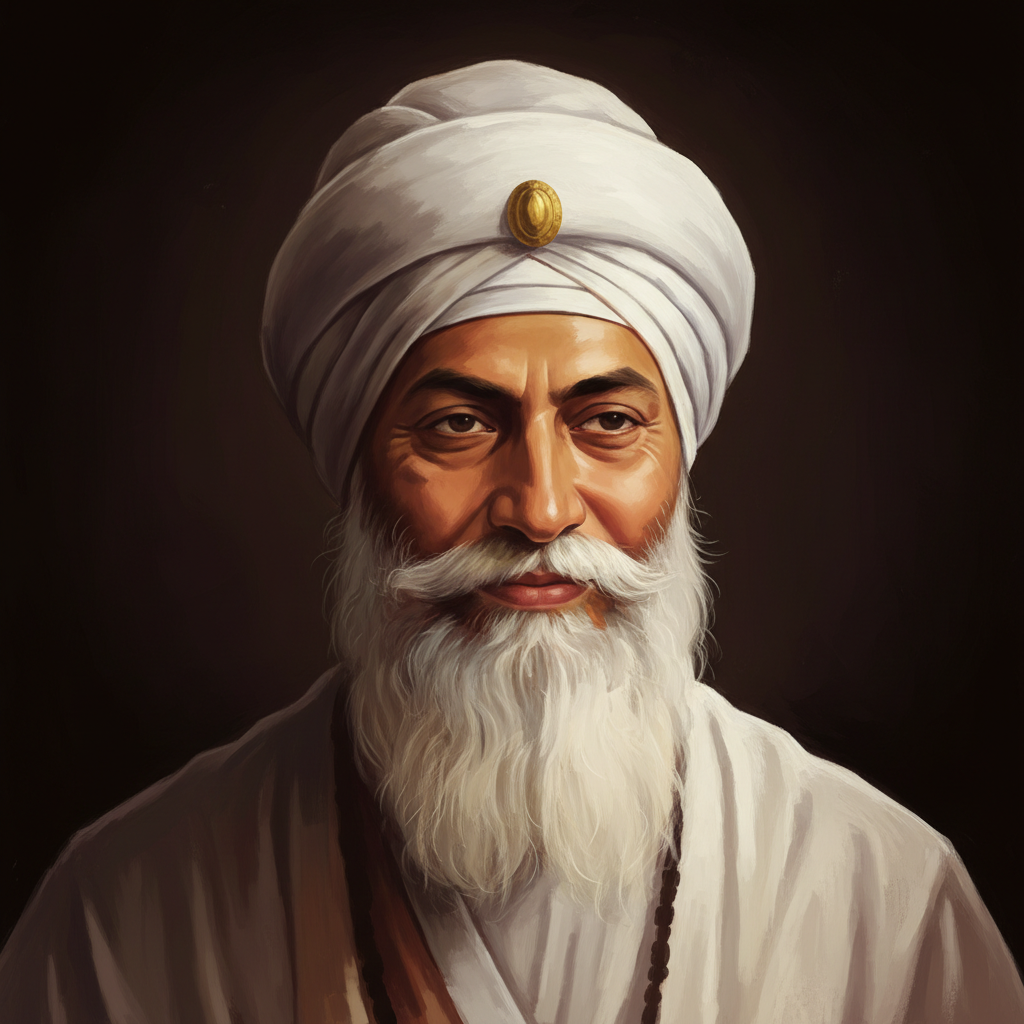
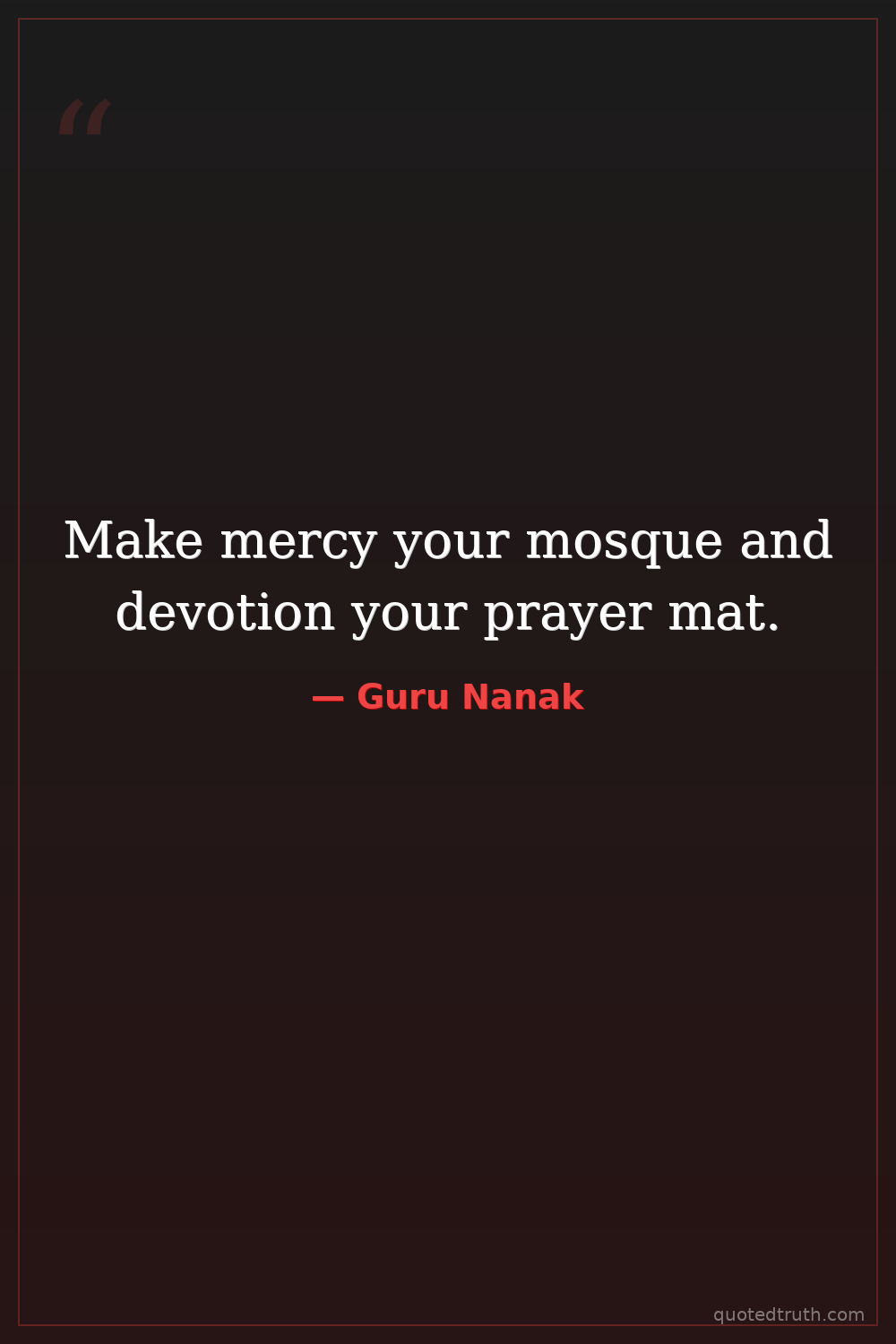
Guru Nanak — "Make mercy your mosque and devotion your prayer mat."
Make mercy your mosque and devotion your prayer mat.
Make mercy your mosque and devotion your prayer mat.
Click any product to generate a realistic preview. Up to 3 at a time.
* Initial load can take up to 90 seconds — revising the preview in another color is nearly instant.
"Through suffering, one learns to love God."
"Let no one be proud of his caste; he who knows God is a Brahmin."
"The world is suffering in falsehood, and only truth can save it."
"One cannot comprehend Him through the intellect, even if one were to try a hundred thousand times."
"Without the Naam, life is a waste."
Founder of Sikhism and the first of the Ten Sikh Gurus, whose teachings of one universal God and rejection of caste shaped Punjab. Closely associated with Kabir (mystical poet whose verses appear in the Sikh Guru Granth Sahib). For an intellectual contrast, see Brahmanical orthodoxy, the Hindu caste-and-ritual establishment of his era — Sikhism was founded as a deliberate alternative to both Hindu ritual hierarchy and Islamic exclusivism — Nanak's universalism was a structural rejection of caste and priestly mediation.
Found in 1 providers: gemini
1 source checked
Real religion is not about buildings, rituals, or outward ceremonies. Instead of seeking holiness in a physical place of worship or on a specific object, carry compassion wherever you go and let sincere love for the divine be the surface on which you stand. Kindness toward others becomes the sanctuary, and heartfelt devotion becomes the discipline. Where you pray matters far less than how you treat people and whether your inner life is genuinely oriented toward God.
Guru Nanak (1469–1539) founded Sikhism by rejecting empty ritualism in both Hinduism and Islam and teaching that one formless God is reached through honest living, remembrance, and service. He traveled widely, dialogued with Hindu pandits and Muslim clerics, and insisted inner virtue outweighs caste, pilgrimage, or prayer direction. This saying distills his signature move: replacing external religious props with moral qualities like mercy and devotion as the true instruments of worship.
In early sixteenth-century Punjab, Nanak lived under the late Delhi Sultanate and the arriving Mughals, where Hindu temple worship and Islamic mosque prayer were sharply divided, caste rules were rigid, and clerics on both sides emphasized outward form. Religious tension, forced conversions, and ritual gatekeeping were common. By reframing the mosque and prayer mat as mercy and devotion, Nanak challenged communal boundaries and offered a shared interior path that ordinary farmers and traders, excluded from elite ritual, could actually practice.
AI-generated insights based on extensive research and information for context. Factual errors? Email [email protected].
Your cart is empty