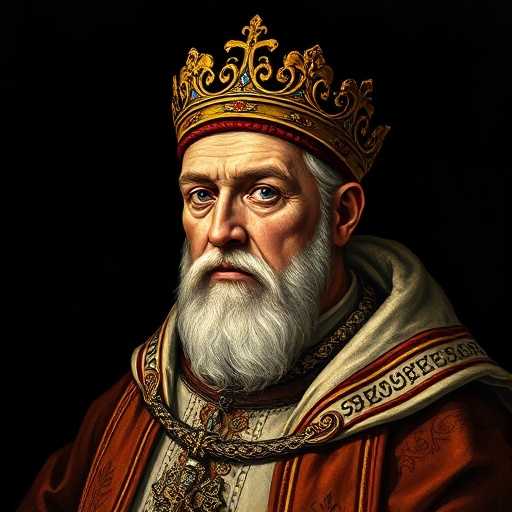
Pope Urban II — "Let our lives be stronger than death to fight against the enemies of the Christi…"
Let our lives be stronger than death to fight against the enemies of the Christian people.
Let our lives be stronger than death to fight against the enemies of the Christian people.
Click any product to generate a realistic preview. Up to 3 at a time.
* Initial load can take up to 90 seconds — revising the preview in another color is nearly instant.
"Go forth, therefore, and cleanse the Holy Sepulchre from the wicked race."
"Enter upon the road to the Holy Sepulcher; wrest that land from the wicked race, and subject it to yourselves."
"This land which as the Scripture says 'floweth with milk and honey,' was given by God into the possession of the children of Israel. Jerusalem is the navel of the world; the land is fruitful above oth…"
"Let those who have been hired as mercenaries for trivial pay, now earn an eternal reward."
"When you have decided to go, you must publicly make your vow and dedicate yourselves to God."
Pope (1088-1099) whose Council of Clermont speech (November 1095) launched the First Crusade — the founding event of nine centuries of Christian-Muslim military conflict. Closely associated with Pope Gregory VII (his predecessor on papal-imperial reform). For an intellectual contrast, see Saladin, Kurdish-Muslim Sultan of Egypt and Syria (1138-1193) — Saladin recaptured Jerusalem in 1187, undoing the First Crusade Urban II launched 92 years earlier. Saladin's chivalrous treatment of Christian prisoners became the canonical Muslim counter-image to Crusader brutality. The cleanest before/after pairing of the Crusades' moral arc.
A call to extreme dedication and sacrifice in the fight against non-Christians. (Attributed in a historical summary)
Date: 1095
ReligiousFound in 1 providers: gemini
1 source checked
The statement calls Christians to treat their courage and resolve as weapons more powerful than the fear of death—to be so committed to defending fellow believers that dying becomes secondary to the mission. It frames self-sacrifice not as loss but as moral strength. The phrase 'enemies of the Christian people' grounds abstract devotion in a concrete, urgent threat, turning personal faith into collective military obligation.
Urban II delivered this sentiment at his Council of Clermont sermon in November 1095, personally igniting the First Crusade. Raised as a Benedictine monk and later a Church reformer under Gregory VII, Urban spent his pontificate fighting simony, lay investiture, and an antipope rival. He understood existential struggle firsthand. His crusade call reflected genuine conviction that protecting Christendom demanded extraordinary personal sacrifice from Christian warriors.
In 1095, Seljuk Turks had captured Jerusalem and routed Byzantine armies, prompting Emperor Alexios I to beg Western military aid. Feudal Europe overflowed with armed knights lacking sanctioned purpose, and the Church sought to redirect internal Christian violence outward. Pilgrimages to the Holy Land had become life-threatening. The Crusading idea fused martyrdom theology with feudal warrior culture at a moment of peak religious anxiety, producing an unprecedented mass military movement.
AI-generated insights based on extensive research and information for context. Factual errors? Email [email protected].
Your cart is empty