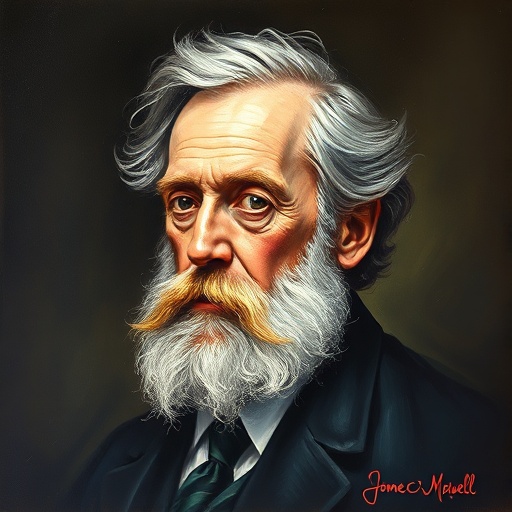
James Clerk Maxwell — "I have looked into most philosophical systems and I have seen that none will wor…"
I have looked into most philosophical systems and I have seen that none will work without God.
I have looked into most philosophical systems and I have seen that none will work without God.
Click any product to generate a realistic preview. Up to 3 at a time.
* Initial load can take up to 90 seconds — revising the preview in another color is nearly instant.
"I have been trying to think what is the difference between an experiment and an experience."
"The opinion seems to have got abroad, that in a few years all the great physical constants will have been approximately estimated, and that the only occupation which will then be left to men of scienc…"
"I have no doubt that there are many persons who would be very glad to get rid of the ether."
"At quite uncertain times and places, The atoms left their heavenly path, And by fortuitous embraces, Engendered all that being hath. And though they seem to cling together, And form 'associations' her…"
"I think men of science as well as other men need to learn from Christ, and I think Christians whose minds are scientific are bound to study science that their view of the glory of God may be as extens…"
Philosophical reflection, likely from letters or essays.
Date: 1870s (approximate)
ReligiousFound in 1 providers: gemini
1 source checked
Maxwell is saying that after studying many frameworks people use to explain reality, morality, and existence, he found each one incomplete or incoherent unless it assumed a divine foundation. Philosophies built purely on human reason or materialism leave gaps they cannot fill on their own terms. For him, God is not an optional add-on but the piece that makes any coherent worldview actually hold together logically and practically.
Maxwell was a devout Presbyterian who saw no conflict between rigorous science and faith. Alongside formulating the equations unifying electricity, magnetism, and light, he wrote prayers, studied theology, and quoted scripture in lectures. He engraved Psalm 111:2 over the Cavendish Laboratory door. Having mastered the most elegant physics of his century, he still concluded that reason alone could not ground reality, making this statement a direct expression of his integrated scientific-religious worldview.
Maxwell lived 1831-1879, squarely in the Victorian crisis of faith. Darwin's Origin of Species (1859), higher biblical criticism, and industrial materialism were pushing elite thinkers toward agnosticism and positivism. Comte, Huxley, and Tyndall argued science was displacing religion. Against this tide, top-tier scientists like Maxwell, Faraday, and Stokes publicly defended Christian belief, making his verdict on philosophical systems a notable counter-statement in a rapidly secularizing intellectual culture.
AI-generated insights based on extensive research and information for context. Factual errors? Email [email protected].
Your cart is empty