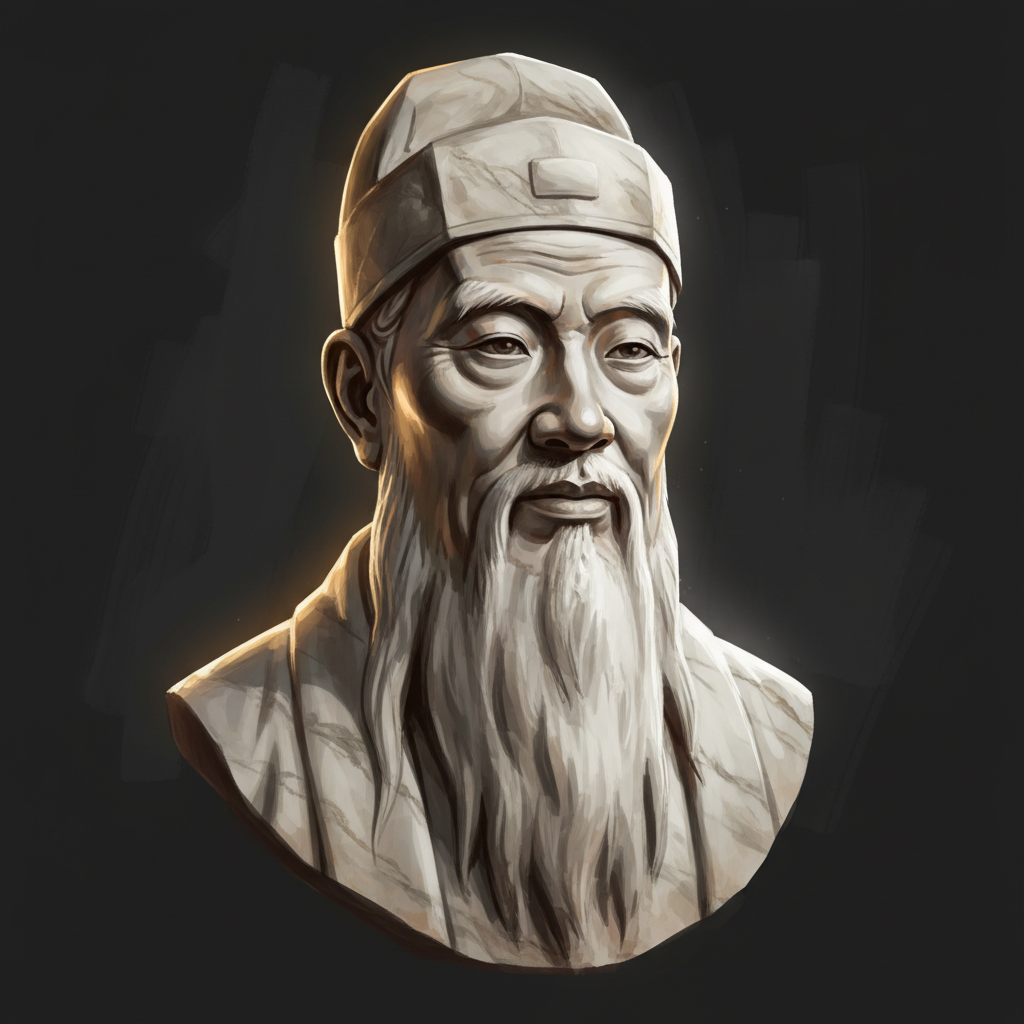
Confucius — "It is man that can make the Way great, and not the Way that can make man great."
It is man that can make the Way great, and not the Way that can make man great.
It is man that can make the Way great, and not the Way that can make man great.
Click any product to generate a realistic preview. Up to 3 at a time.
* Initial load can take up to 90 seconds — revising the preview in another color is nearly instant.
"The superior man is slow in speech but quick in action."
"The gentleman has nothing to contend for."
"The superior man thinks of virtue; the small man thinks of comfort. The superior man thinks of the sanctions of law; the small man thinks of favors which he may receive."
"The superior man understands what is right; the inferior man understands what will sell."
"The Master said, 'The superior man is dignified, but not proud. The mean man is proud, but not dignified.'"
Chinese philosopher and teacher whose teachings (compiled by his students in the Analects) became the foundational ethical framework of East Asian civilization for 2,500 years. Closely associated with Mencius (his most-influential follower a century later). For an intellectual contrast, see Laozi, near-contemporary Chinese sage and Tao Te Ching author — Confucius systematized social order through ritual and family hierarchy; Laozi's Taoist effortless-action philosophy argued such systems were the disease, not the cure. The two founding poles of Chinese moral philosophy — every East Asian moral tradition since has positioned itself between them.
The standard scholarly entry points to Confucius's work: Philip J. Ivanhoe (Georgetown, Chinese philosophy) — Confucian Moral Self Cultivation (2000); Edward Slingerland (UBC, Asian Studies) — Effortless Action: Wu-wei as Conceptual Metaphor (2003); Tu Weiming (Harvard, Confucian scholar) — Confucian Thought: Selfhood as Creative Transformation (1985). These are the works graduate seminars cite when teaching Confucius.
Found in 1 providers: grok
1 source checked
Human beings give meaning and power to principles, not the other way around. A moral path, tradition, or philosophy has no force on its own—it depends entirely on people actively living it, practicing it, and passing it on. You cannot hide behind a doctrine to become virtuous; your choices and effort are what breathe life into any ideal you claim to follow.
Confucius spent his life teaching that virtue comes from personal cultivation, not inherited status or ritual alone. As a traveling teacher rejected by rulers, he insisted ordinary people—through study, self-reflection, and practice of ren (humaneness)—carry moral tradition forward. He refused to treat the Way as a mystical force; it was a human project requiring disciplined effort, exactly the kind he demanded from his disciples.
Confucius lived during the Spring and Autumn period (roughly 551–479 BCE), when the Zhou dynasty's authority was collapsing and warring states jockeyed for power. Rituals and social bonds were eroding, and many blamed fate or heaven's will. Confucius pushed back, insisting that restoring order depended on human agency—educated officials and cultivated gentlemen—rather than waiting for cosmic forces to correct a disintegrating society.
AI-generated insights based on extensive research and information for context. Factual errors? Email [email protected].
Your cart is empty