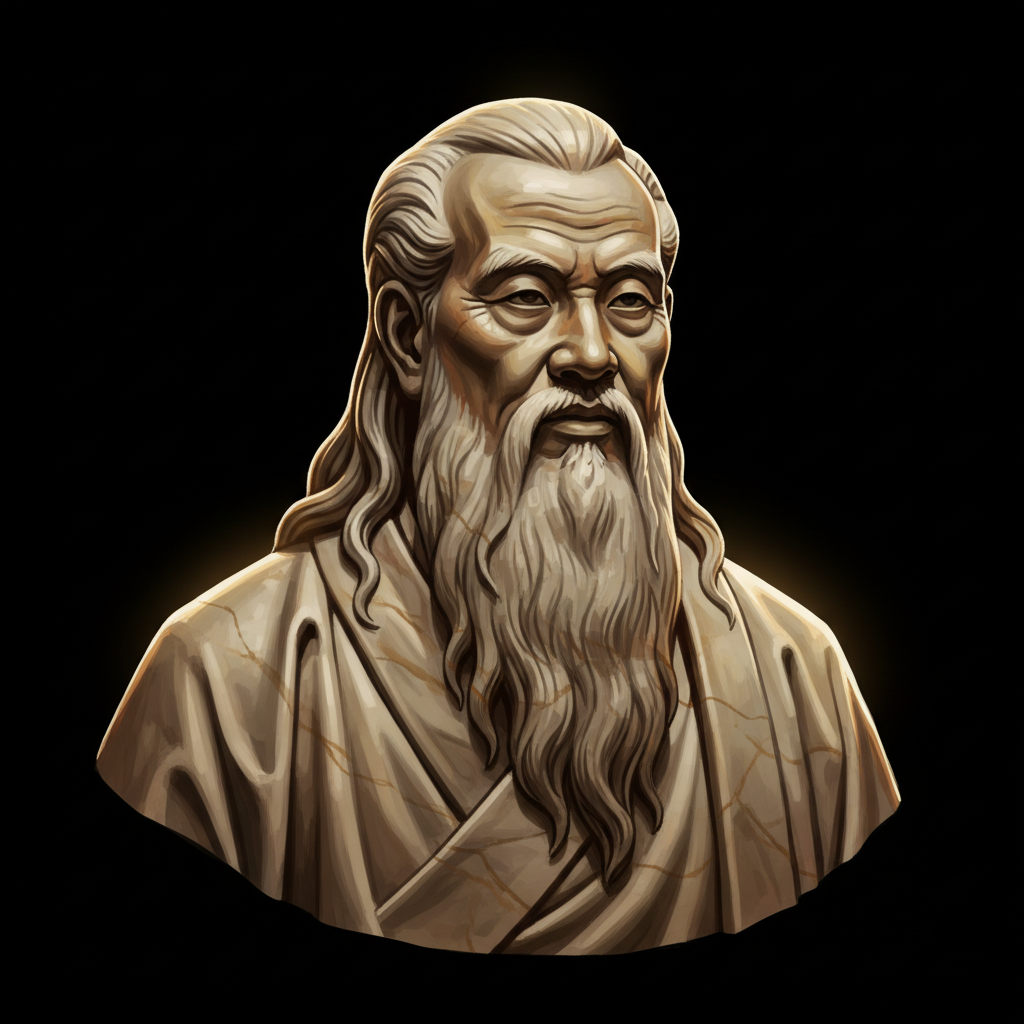
Laozi — "Fame or integrity: which is more important? Money or happiness: which is more pr…"
Fame or integrity: which is more important? Money or happiness: which is more precious?
Fame or integrity: which is more important? Money or happiness: which is more precious?
Click any product to generate a realistic preview. Up to 3 at a time.
* Initial load can take up to 90 seconds — revising the preview in another color is nearly instant.
"The wise man's food is that which nourishes him; the fool's food is that which gratifies him."
"The Sage manages affairs without doing anything, and spreads doctrines without speaking."
"The Way is ever without action, yet nothing is left undone."
"By letting it go it all gets done. The world is won by those who let it go. But when you try and try. The world is beyond the winning."
"Simplicity has no name is free of desires. Being free of desires it is tranquil. And the world will be at peace of it's own accord."
Reputed founder of Taoism and author of the Tao Te Ching, whose wu wei (effortless action) shaped East Asian philosophy. Closely associated with Zhuangzi (later Taoist who extended Laozi's framework). For an intellectual contrast, see Confucius, near-contemporary Chinese sage of social ritual and duty — Confucius systematized social order through ritual and hierarchy; Laozi argued that all such systems were the disease, not the cure — the two founding poles of Chinese moral philosophy.
Found in 1 providers: grok
1 source checked
The quote asks readers to rank what they truly value. When forced to choose between reputation and inner honesty, or between wealth and contentment, which would you sacrifice the other for? Most people chase fame and money by default, but Laozi pushes back: the pursuit itself often costs you the deeper thing. Recognize the trade-off before life forces the choice on you, and you will protect what actually sustains a person.
Laozi reportedly served as a keeper of royal archives in the Zhou court, where he watched officials compete for status and wealth. Disillusioned, tradition says he rode west out of civilization entirely, writing the Tao Te Ching only at the border keeper's request. The questions mirror his own refusal: he walked away from fame and income to preserve integrity and inner peace, embodying the wu wei and simplicity central to Taoism.
Laozi lived during the late Zhou dynasty, a period of collapsing feudal order bleeding into the Warring States era. Nobles schemed for titles, scholars roamed selling advice to ambitious rulers, and warfare grew constant. Confucius was codifying hierarchy and ritual as the answer; Laozi offered the opposite diagnosis, arguing the striving itself was the disease. In that climate of naked ambition and shifting loyalties, questioning whether fame and money were worth their cost was radical.
AI-generated insights based on extensive research and information for context. Factual errors? Email [email protected].
Your cart is empty