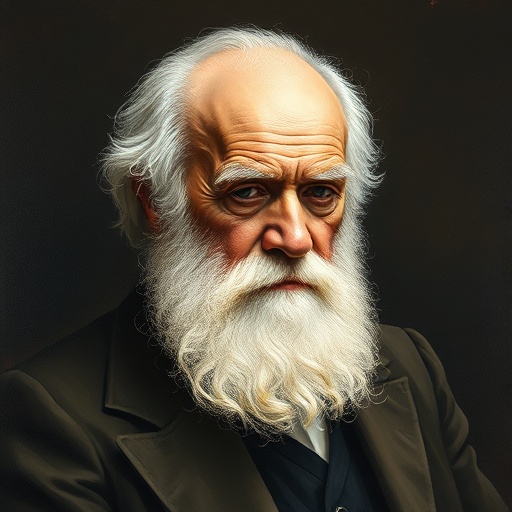
Charles Darwin — "I am almost convinced (quite contrary to opinion I started with) that species ar…"
I am almost convinced (quite contrary to opinion I started with) that species are not (it is like confessing a murder) immutable.
I am almost convinced (quite contrary to opinion I started with) that species are not (it is like confessing a murder) immutable.
Click any product to generate a realistic preview. Up to 3 at a time.
* Initial load can take up to 90 seconds — revising the preview in another color is nearly instant.
"I am a strong believer in the power of observation and the importance of collecting facts."
"We are not here concerned with the first origin of life."
"To kill an error is as good a service as to establish a new truth."
"I have gradually come to disbelieve in Christianity as a divine revelation."
"My mind seems to have become a kind of machine for grinding general laws out of large collections of facts, but why this should have caused the atrophy of that part of the brain alone, on which the hi…"
British naturalist whose On the Origin of Species (1859) established evolution by natural selection — the unifying theory of modern biology. Closely associated with Thomas Henry Huxley (his 'bulldog' public defender) and Alfred Russel Wallace (independent co-discoverer of natural selection). For an intellectual contrast, see William Paley, Anglican theologian and Natural Theology author (1743-1805) — Origin of Species is structurally a 400-page reply to Paley — Darwin admired Paley's watchmaker-argument as an undergraduate at Cambridge and then spent 20 years building the empirical machinery to displace him. The cleanest 'design argument vs natural selection' founding rebuttal in science.
The standard scholarly entry points to Charles Darwin's work: Janet Browne (Harvard, history of science) — Charles Darwin: Voyaging (1995) and The Power of Place (2002); Adrian Desmond (UCL, biographer) — Darwin: The Life of a Tormented Evolutionist (1991, with James Moore). These are the works graduate seminars cite when teaching Charles Darwin.
From a letter to J.D. Hooker, revealing his internal struggle with accepting the mutability of species.
Date: 1844
Life & DeathFound in 1 providers: gemini
1 source checked
Darwin is admitting—with visible anxiety—that he now believes species can change over time, the opposite of what he accepted when he began his career. The parenthetical comparison to 'confessing a murder' captures how dangerous this idea felt: it would overturn centuries of religious and scientific orthodoxy. He is not fully certain yet, but accumulated evidence has pushed him to the threshold of a conclusion that would permanently reshape biology.
Darwin sailed as a conventional Anglican naturalist on the HMS Beagle (1831–1836), fully accepting that species were fixed by God's design. His observations of Galápagos finches, tortoises, and South American fossils gradually dismantled that belief. Written in an 1844 letter to botanist Joseph Hooker, this confession captures Darwin thirteen years before On the Origin of Species—already convinced but terrified to say so publicly, knowing it would collide head-on with religious doctrine and his own earlier convictions.
In 1844, both science and Christian theology held species to be God's fixed creations, immutable since Genesis. Natural theology, epitomized by William Paley's divine watchmaker argument, dominated British intellectual life. Charles Lyell's geology was quietly revealing Earth's vast age, creating mounting tension with scripture. Lamarck's earlier evolutionary ideas had been broadly dismissed. The Church of England still shaped academic reputations and appointments. To suggest species changed was to challenge divine creation openly—professional and social suicide in Victorian England.
AI-generated insights based on extensive research and information for context. Factual errors? Email [email protected].
Your cart is empty