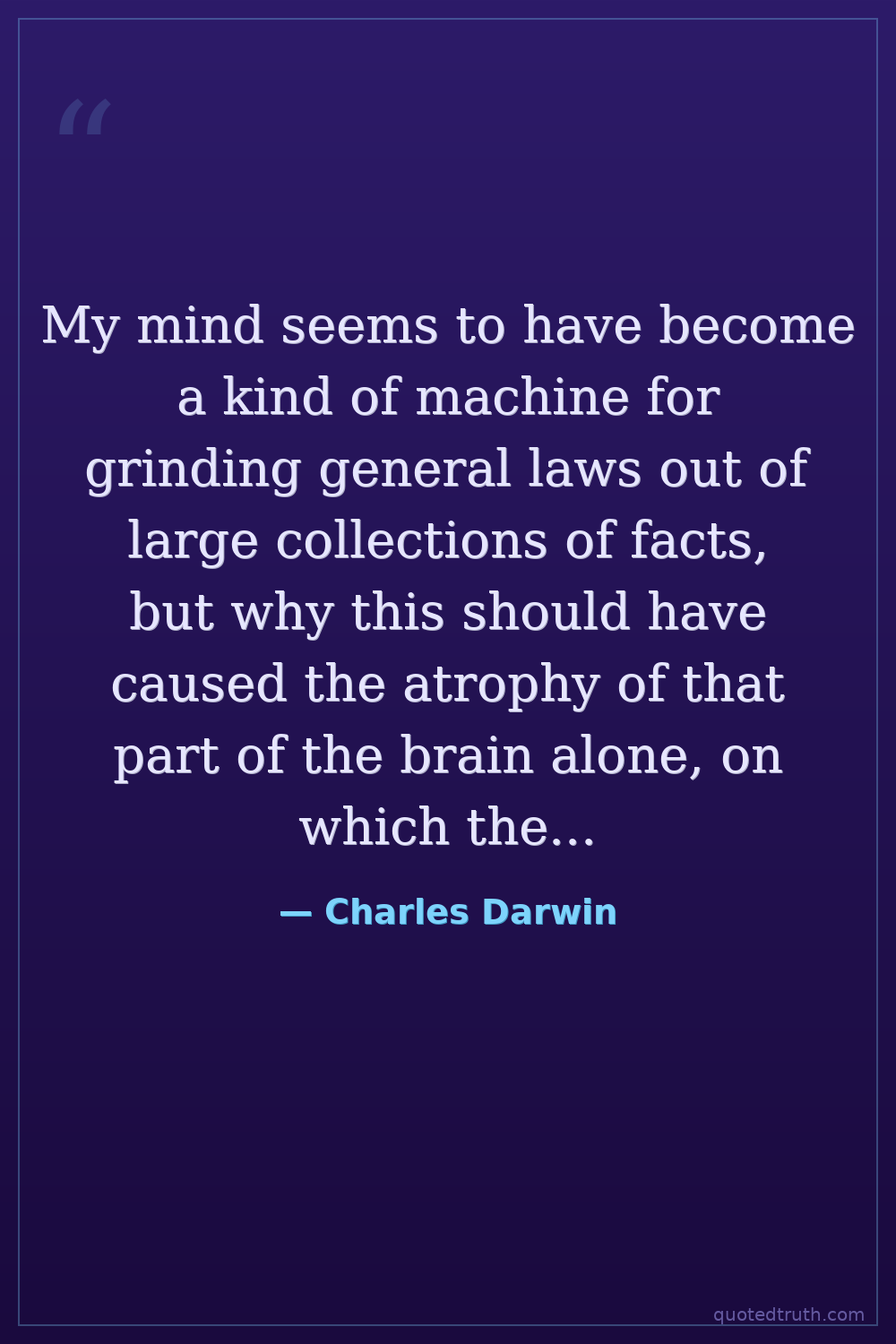
Charles Darwin — "My mind seems to have become a kind of machine for grinding general laws out of …"

My mind seems to have become a kind of machine for grinding general laws out of large collections of facts, but why this should have caused the atrophy of that part of the brain alone, on which the higher tastes depend, I cannot conceive.
Charles Darwin — Charles Darwin Modern · Theory of evolution

Get This Quote & Author's Image Illustrated On:

Click any product to generate a realistic preview. Up to 3 at a time.
* Initial load can take up to 90 seconds — revising the preview in another color is nearly instant.

Kitchen

Apparel

Other

About Charles Darwin (1809-1882)

British naturalist whose On the Origin of Species (1859) established evolution by natural selection — the unifying theory of modern biology. Closely associated with Thomas Henry Huxley (his 'bulldog' public defender) and Alfred Russel Wallace (independent co-discoverer of natural selection). For an intellectual contrast, see William Paley, Anglican theologian and Natural Theology author (1743-1805) — Origin of Species is structurally a 400-page reply to Paley — Darwin admired Paley's watchmaker-argument as an undergraduate at Cambridge and then spent 20 years building the empirical machinery to displace him. The cleanest 'design argument vs natural selection' founding rebuttal in science.

The standard scholarly entry points to Charles Darwin's work: Janet Browne (Harvard, history of science) — Charles Darwin: Voyaging (1995) and The Power of Place (2002); Adrian Desmond (UCL, biographer) — Darwin: The Life of a Tormented Evolutionist (1991, with James Moore). These are the works graduate seminars cite when teaching Charles Darwin.

Details

Autobiography

Date: 1876

Art & Creativity

Verification

Unverifiable

Found in 1 providers: grok

1 source checked

Understanding this quote

What it means

The speaker describes how relentless analytical thinking transformed their mind into a fact-processing engine, crowding out aesthetic sensibilities like appreciation for music, poetry, and art. Years of grinding through evidence to extract universal principles left the emotional, imaginative faculties withered and unused. It is a lament about intellectual specialization's hidden cost: gaining scientific power while losing the capacity for beauty and wonder.

Relevance to Charles Darwin

Darwin wrote this in his autobiography, noting that in youth he loved poetry, music, and painting, but decades of natural selection research dulled those pleasures entirely. His life exemplified radical empirical discipline — cataloguing barnacles, breeding pigeons, correlating fossil records — and he genuinely mourned this trade-off, calling it a loss of happiness and possibly harmful to his intellect and moral character.

The era

Darwin wrote during the Victorian era, when science was professionalizing and specializing rapidly. The Romantic movement had earlier celebrated unified genius — scientific and artistic sensibility together — in figures like Goethe and Humboldt. By Darwin's mid-century moment, industrial-age empiricism demanded narrow depth, and intellectuals increasingly worried that mechanized thinking threatened humanistic culture, a tension Darwin embodied personally and expressed with unusual candor.

AI-generated insights based on extensive research and information for context. Factual errors? Email [email protected].
Your Cart

Your cart is empty