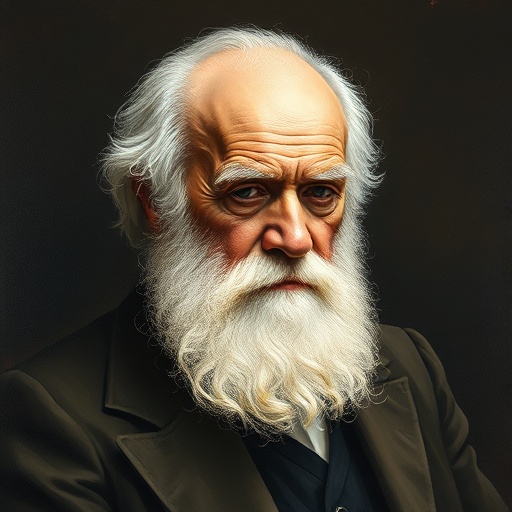
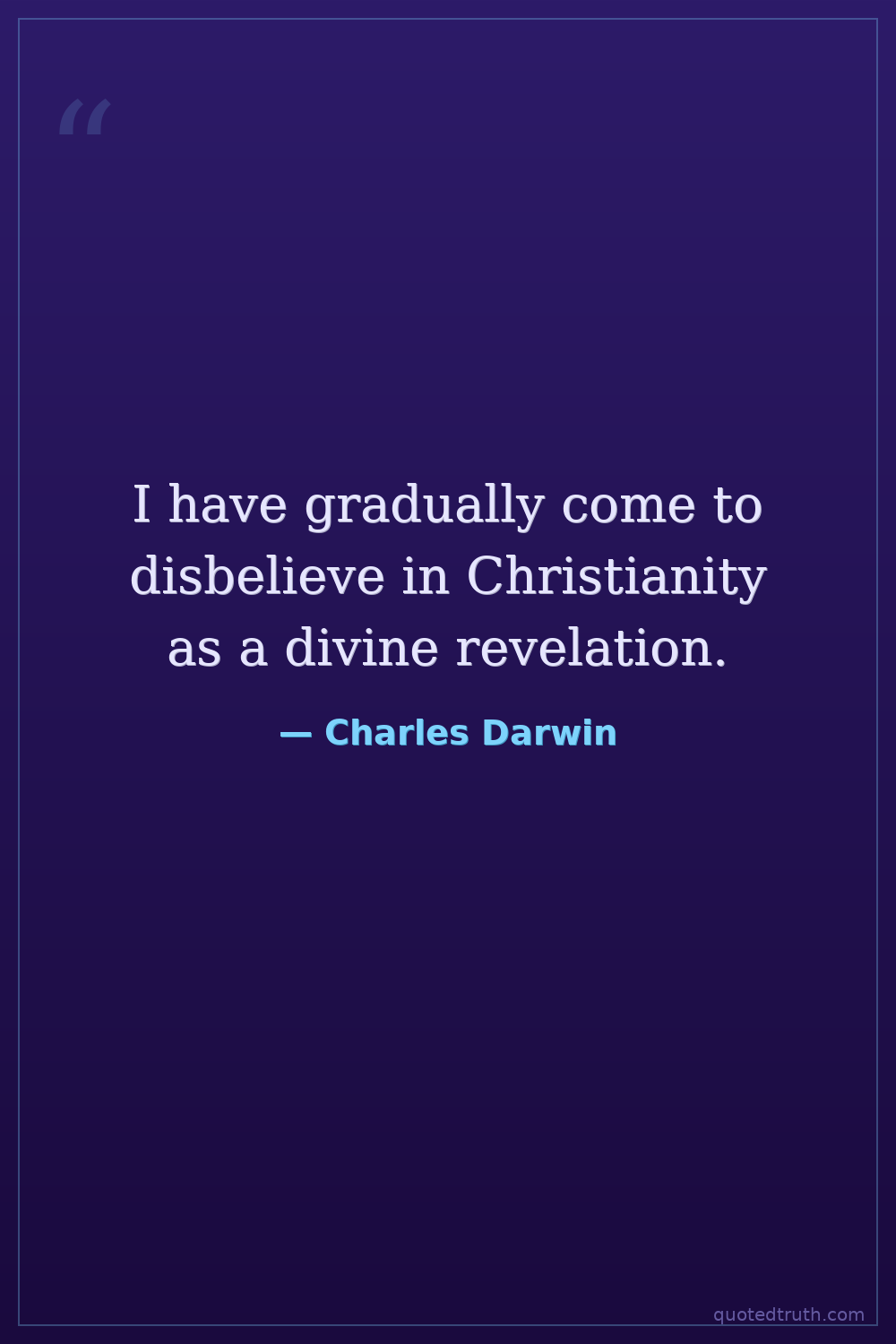
Charles Darwin — "I have gradually come to disbelieve in Christianity as a divine revelation."
I have gradually come to disbelieve in Christianity as a divine revelation.
I have gradually come to disbelieve in Christianity as a divine revelation.
Click any product to generate a realistic preview. Up to 3 at a time.
* Initial load can take up to 90 seconds — revising the preview in another color is nearly instant.
"To kill an error is as good a service as to establish a new truth."
"It is a wonderful fact that we can understand so much."
"A dog might as well speculate on the mind of Newton."
"But I am very poorly today and very stupid and hate everybody and everything."
"There is grandeur in this view of life, with its several powers, having been originally breathed into a few forms or into one; and that whilst this planet has gone cycling on according to the fixed la…"
British naturalist whose On the Origin of Species (1859) established evolution by natural selection — the unifying theory of modern biology. Closely associated with Thomas Henry Huxley (his 'bulldog' public defender) and Alfred Russel Wallace (independent co-discoverer of natural selection). For an intellectual contrast, see William Paley, Anglican theologian and Natural Theology author (1743-1805) — Origin of Species is structurally a 400-page reply to Paley — Darwin admired Paley's watchmaker-argument as an undergraduate at Cambridge and then spent 20 years building the empirical machinery to displace him. The cleanest 'design argument vs natural selection' founding rebuttal in science.
The standard scholarly entry points to Charles Darwin's work: Janet Browne (Harvard, history of science) — Charles Darwin: Voyaging (1995) and The Power of Place (2002); Adrian Desmond (UCL, biographer) — Darwin: The Life of a Tormented Evolutionist (1991, with James Moore). These are the works graduate seminars cite when teaching Charles Darwin.
Found in 1 providers: grok
1 source checked
Darwin's slow, honest admission that evidence and reasoning eroded his Christian faith over time. The word 'gradually' signals no dramatic break — it was a quiet intellectual reckoning. He specifically doubts Christianity as divine revelation, meaning the Bible as God's direct word, not all spirituality. It captures the integrity of someone following evidence wherever it leads, even when the destination is personally and socially costly.
Darwin trained for the clergy at Cambridge before the Beagle voyage reshaped his worldview. His theory of natural selection replaced divine design with blind variation — directly undermining Genesis. The 1851 death of his ten-year-old daughter Annie deepened his estrangement from faith. He called himself agnostic in later life. This quote comes from his private autobiography, written candidly for family, a confession he knew would unsettle Victorian society.
Victorian Britain paired intense religious authority with explosive scientific discovery. The Church of England shaped education, morality, and social standing. Simultaneously, Lyell's geology stretched Earth's age far beyond Genesis, German Higher Criticism questioned biblical authorship, and Darwin's own evolution dissolved the argument from design. Public atheism was socially ruinous, yet private doubt was widespread among intellectuals. Darwin's confession crystallized the era's defining conflict: scripture versus natural evidence.
AI-generated insights based on extensive research and information for context. Factual errors? Email [email protected].
Your cart is empty