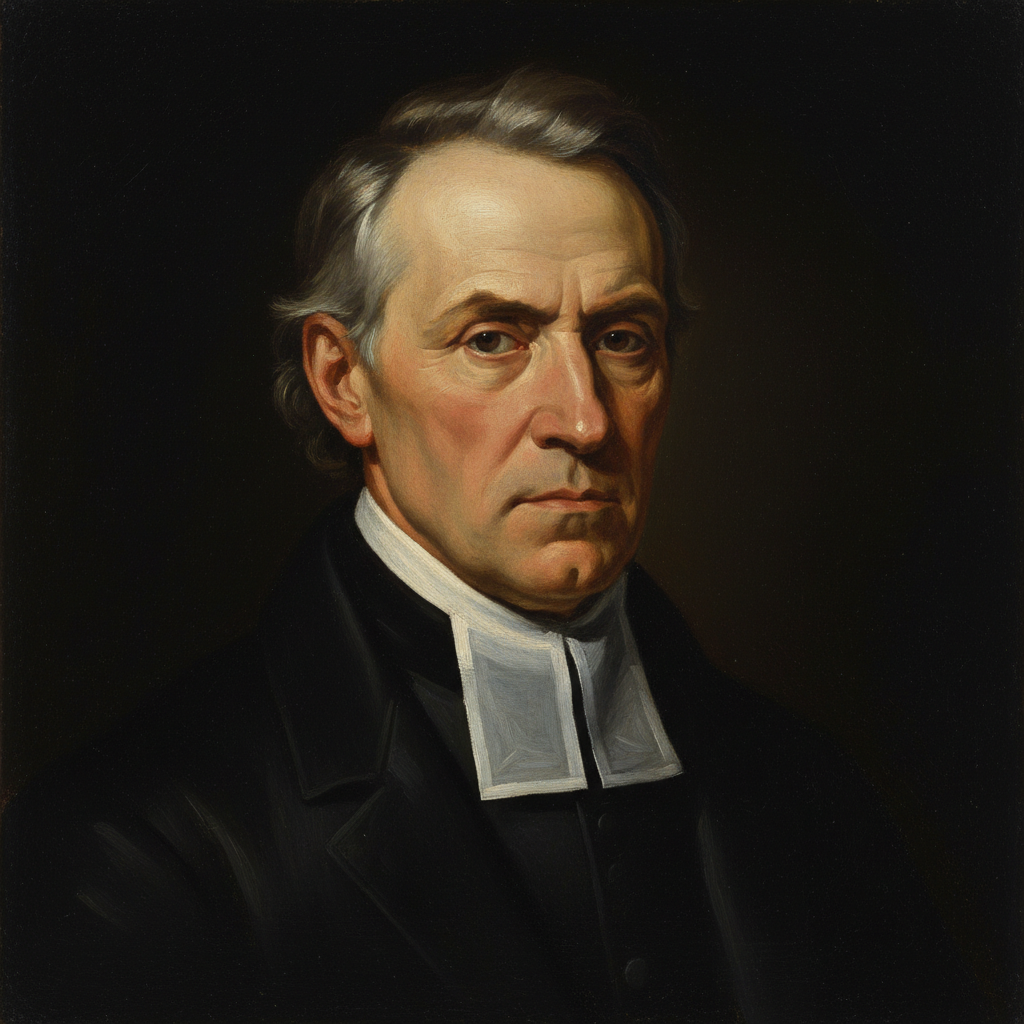
John Wesley — "I should be glad if I could spend my whole life in reading and writing."
I should be glad if I could spend my whole life in reading and writing.
I should be glad if I could spend my whole life in reading and writing.
Click any product to generate a realistic preview. Up to 3 at a time.
* Initial load can take up to 90 seconds — revising the preview in another color is nearly instant.
"I am as much a High-Churchman as ever I was. And I hope to live and die so."
"God loves a cheerful giver."
"I have often thought, that if I were to choose a profession, it should be that of a physician."
"To candid, reasonable men, I am not afraid to lay open what has been the course of my life."
"What a work has God wrought in our day!"
English Anglican cleric and founder of Methodism, whose open-air preaching and class-meeting structure created the largest 18th-century evangelical revival. Closely associated with Charles Wesley (his hymn-writing brother) and George Whitefield (early co-revivalist, later doctrinal opponent). For an intellectual contrast, see George Whitefield, Calvinist evangelical revivalist — Whitefield's predestinarian Calvinism vs Wesley's free-grace Arminian theology split the early Methodist movement permanently in the 1739-41 break. The founding evangelical Calvinist-Arminian schism — the two parallel evangelical traditions American Christianity descends from.
Found in 1 providers: grok
1 source checked
The speaker wishes they could devote their entire life to intellectual pursuits—absorbing knowledge through reading and producing ideas through writing. It expresses a deep love of learning and a recognition that these activities feel most fulfilling and meaningful, more than any other obligation or distraction life demands.
Wesley was extraordinarily prolific, publishing over 400 works including sermons, journals, hymn collections, and theological tracts. He read voraciously on horseback during his 250,000-mile ministry travels. His life was defined by disciplined scholarship alongside evangelical preaching, making this longing for pure intellectual life a genuine tension he personally felt against his relentless pastoral duties.
The 18th-century Enlightenment made literacy and print culture central to intellectual identity. The printing press had democratized knowledge, and educated clergy were expected to engage philosophy, science, and theology simultaneously. Wesley lived amid explosive growth in publishing, Methodist circuit riders spread tracts widely, and literacy campaigns transformed religious life across Britain and the American colonies.
AI-generated insights based on extensive research and information for context. Factual errors? Email [email protected].
Your cart is empty