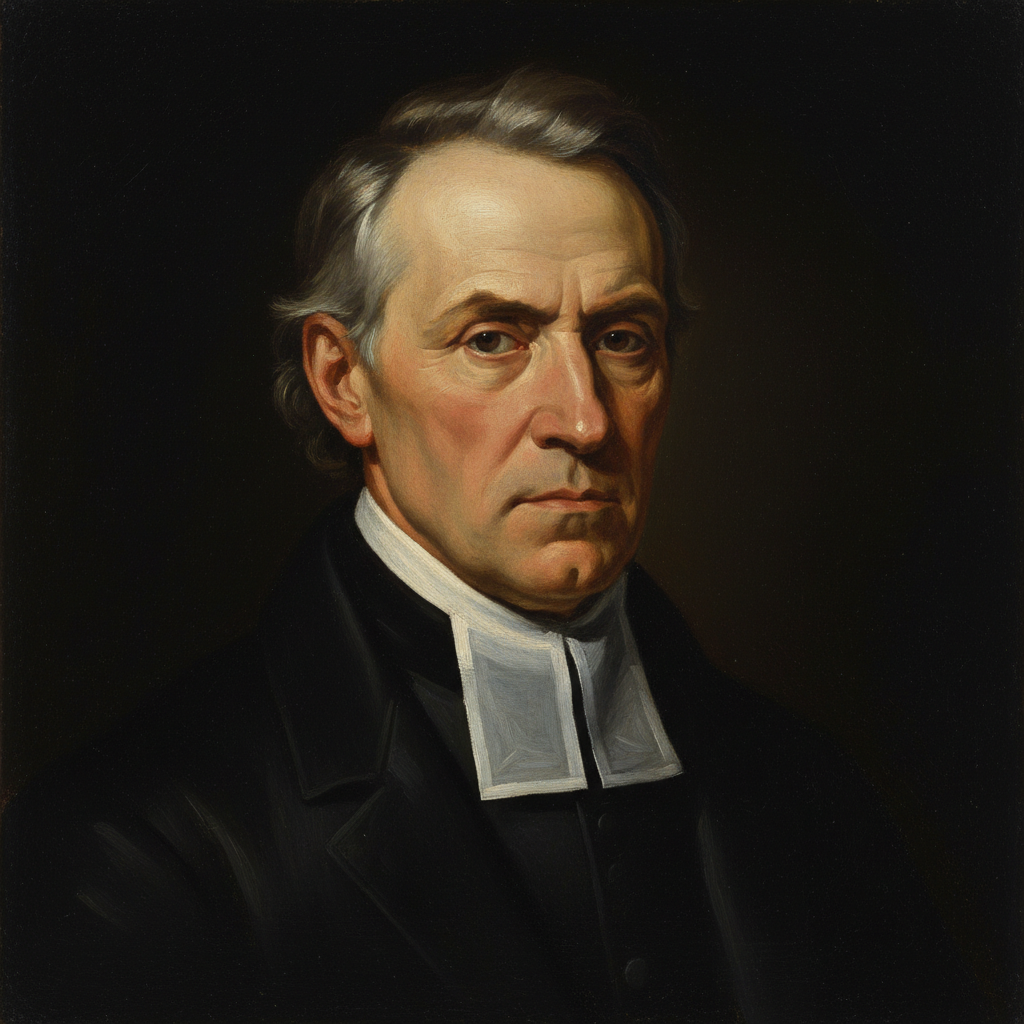
John Wesley — "God loves a cheerful giver."
God loves a cheerful giver.
God loves a cheerful giver.
Click any product to generate a realistic preview. Up to 3 at a time.
* Initial load can take up to 90 seconds — revising the preview in another color is nearly instant.
"I have often thought, that if I were to choose a time to live, it should be in the first ages of Christianity."
"The rich, the honourable, the great, will hardly enter into the kingdom of heaven."
"Preach not doctrines, but Christ."
"I am as much a High-Churchman as ever I was. And I hope to live and die so."
"I am a creature of a day, passing through life as an arrow through the air. I am a spirit come from God, and returning to God; just hovering a few moments over a great gulf, till, on a sudden, I drop …"
English Anglican cleric and founder of Methodism, whose open-air preaching and class-meeting structure created the largest 18th-century evangelical revival. Closely associated with Charles Wesley (his hymn-writing brother) and George Whitefield (early co-revivalist, later doctrinal opponent). For an intellectual contrast, see George Whitefield, Calvinist evangelical revivalist — Whitefield's predestinarian Calvinism vs Wesley's free-grace Arminian theology split the early Methodist movement permanently in the 1739-41 break. The founding evangelical Calvinist-Arminian schism — the two parallel evangelical traditions American Christianity descends from.
Found in 1 providers: grok
1 source checked
True generosity comes from a willing heart, not obligation or pressure. Drawn from 2 Corinthians 9:7, the quote asserts that the spirit behind an act of giving matters as much as the gift itself. Reluctant or compelled giving loses its moral weight. Authentic charity is joyful and voluntary — an expression of genuine love and gratitude rather than social duty or fear of judgment.
Wesley practiced radical personal frugality while giving away most of his substantial income from book sales. His famous maxim — earn all you can, save all you can, give all you can — made cheerful generosity a Methodist cornerstone. He personally distributed money to the poor, visited debtors' prisons, and built schools for impoverished children. For Wesley, financial stewardship was inseparable from Christian faith and salvation.
Eighteenth-century England saw widening inequality as early industrialization displaced rural workers and swelled urban slums. The Church of England catered largely to the propertied class, neglecting the laboring poor. Compulsory parish poor rates made charity feel like taxation rather than virtue. Wesley's Methodist revival placed voluntary, joyful giving at its center — a direct rebuke to indifferent established religion and the coerced, grudging almsgiving of the era.
AI-generated insights based on extensive research and information for context. Factual errors? Email [email protected].
Your cart is empty