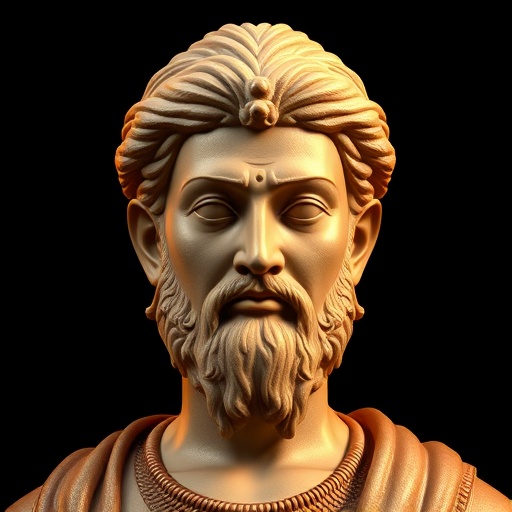
Mahavira — "Conquer anger by forgiveness, pride by humility, deceit by straightforwardness, …"
Conquer anger by forgiveness, pride by humility, deceit by straightforwardness, and greed by contentment.
Conquer anger by forgiveness, pride by humility, deceit by straightforwardness, and greed by contentment.
Click any product to generate a realistic preview. Up to 3 at a time.
* Initial load can take up to 90 seconds — revising the preview in another color is nearly instant.
"A wise man should abstain from killing any living being."
"The soul is neither male nor female."
"Ignorance is the root of all misery."
"All living beings are endowed with consciousness."
"The greatest mistake of a soul is non-restraint."
24th and last Tirthankara of Jainism, whose teachings of strict ahimsa (non-violence), aparigraha (non-attachment), and karma reshaped ancient Indian religion. Closely associated with The Buddha (near-contemporary moral revolutionary, also reacting against Vedic ritualism). For an intellectual contrast, see Vedic Brahmanical ritual sacrifice, the animal-sacrifice-centered Vedic religion of his era — Mahavira's ahimsa demanded total non-violence, including not eating root vegetables that kill the plant — a maximum-distance ethical move from the Vedic priestly tradition that ritually sacrificed cattle and horses. The two cleanest poles of ancient Indian religious ethics.
Found in 1 providers: grok
1 source checked
Negative emotions and vices are best defeated not by force but by their opposites. Anger dissolves when met with forgiveness rather than retaliation. Pride crumbles under genuine humility. Deception loses power against honesty. Greed quiets when you cultivate satisfaction with what you have. Each vice carries its own antidote within human character, requiring inner discipline rather than external control.
Mahavira spent 12 years in severe ascetic practice, renouncing all possessions, enduring hardship without retaliation, and maintaining equanimity against abuse. These four conquests mirror his personal journey: he forgave attackers, shed royal pride by becoming a wandering monk, preached radical truthfulness (satya), and practiced complete non-possession (aparigraha), one of Jainism's five fundamental vows.
Mahavira lived circa 599–527 BCE in northeastern India during the Shramana movement, a period of intense philosophical rebellion against Brahminical ritual authority and the caste system. Greed, war, and social hierarchy dominated. His teachings directly challenged a society where anger justified violence, pride upheld caste, and accumulation signaled status, making inner conquest a radical political and spiritual act.
AI-generated insights based on extensive research and information for context. Factual errors? Email [email protected].
Your cart is empty