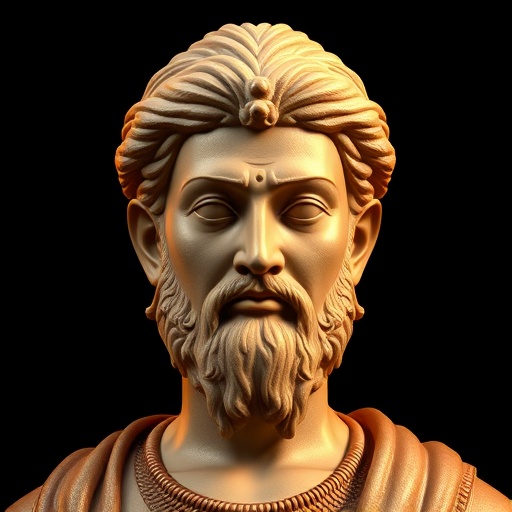
Mahavira — "One who has conquered himself is truly a hero."
One who has conquered himself is truly a hero.
One who has conquered himself is truly a hero.
Click any product to generate a realistic preview. Up to 3 at a time.
* Initial load can take up to 90 seconds — revising the preview in another color is nearly instant.
"Look at the birds, how they live in the present, with no thought for the morrow."
"The light of knowledge dispels the darkness of ignorance."
"The true nature of the soul is bliss."
"The soul is the perceiver, the knower, the agent, the enjoyer, and the sufferer."
"The greatest mistake of a soul is non-restraint."
24th and last Tirthankara of Jainism, whose teachings of strict ahimsa (non-violence), aparigraha (non-attachment), and karma reshaped ancient Indian religion. Closely associated with The Buddha (near-contemporary moral revolutionary, also reacting against Vedic ritualism). For an intellectual contrast, see Vedic Brahmanical ritual sacrifice, the animal-sacrifice-centered Vedic religion of his era — Mahavira's ahimsa demanded total non-violence, including not eating root vegetables that kill the plant — a maximum-distance ethical move from the Vedic priestly tradition that ritually sacrificed cattle and horses. The two cleanest poles of ancient Indian religious ethics.
Found in 1 providers: grok
1 source checked
Real heroism isn't defeating enemies in battle or accumulating power — it's mastering your own impulses, desires, anger, and ego. Controlling your inner world is harder than any external conquest. A person who governs their own passions and attachments has achieved something most never manage. True strength comes from self-discipline: resisting temptation, overcoming fear, and quieting mental chaos rather than dominating other people.
Mahavira renounced his royal family and wealth at thirty to pursue liberation through extreme asceticism. He spent twelve years in silent meditation, enduring hardship without retaliation, owning nothing, harming nothing. His path demanded conquering the four inner passions — anger, pride, deceit, and greed — which Jainism calls kashayas. Self-conquest wasn't metaphor; it was his literal biography. This quote is essentially a summary of his entire life's work and the ethical heart of Jain practice.
Mahavira lived in sixth-century BCE northern India — an era of warring kingdoms where military conquest defined greatness. The same period produced the Buddha and major Upanishadic philosophy, a time of radical questioning. Vedic culture glorified ritual sacrifice and battlefield valor. Into this warrior-dominated world, Mahavira proposed a complete inversion: the real battlefield is internal and the true enemy is your own passion and ego. Jainism emerged as a direct counter-ideal to violent power.
AI-generated insights based on extensive research and information for context. Factual errors? Email [email protected].
Your cart is empty