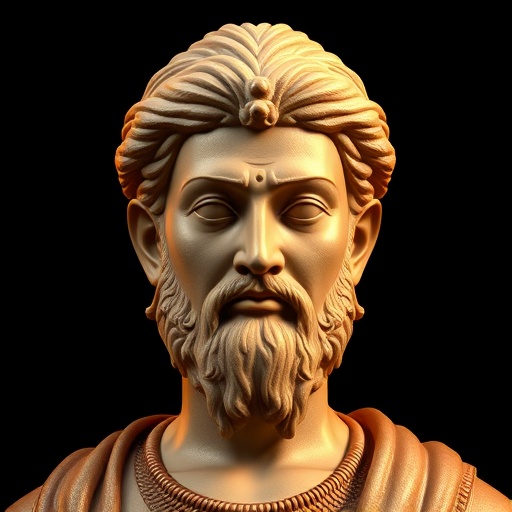
Mahavira — "The soul can be liberated from the cycle of birth and death through right faith,…"
The soul can be liberated from the cycle of birth and death through right faith, right knowledge, and right conduct.
The soul can be liberated from the cycle of birth and death through right faith, right knowledge, and right conduct.
Click any product to generate a realistic preview. Up to 3 at a time.
* Initial load can take up to 90 seconds — revising the preview in another color is nearly instant.
"The universe is a beginningless and endless cycle of creation and destruction."
"Truth is the very nature of the soul."
"Respect for all living beings is Jainism."
"The path of non-violence is the path of enlightenment."
"Live and allow others to live; hurt no one; life is dear to all living beings."
24th and last Tirthankara of Jainism, whose teachings of strict ahimsa (non-violence), aparigraha (non-attachment), and karma reshaped ancient Indian religion. Closely associated with The Buddha (near-contemporary moral revolutionary, also reacting against Vedic ritualism). For an intellectual contrast, see Vedic Brahmanical ritual sacrifice, the animal-sacrifice-centered Vedic religion of his era — Mahavira's ahimsa demanded total non-violence, including not eating root vegetables that kill the plant — a maximum-distance ethical move from the Vedic priestly tradition that ritually sacrificed cattle and horses. The two cleanest poles of ancient Indian religious ethics.
Found in 1 providers: grok
1 source checked
You can escape the endless cycle of reincarnation by cultivating three things simultaneously: genuine belief in the nature of reality, clear and accurate understanding of truth, and ethical behavior in daily life. These aren't separate practices but a unified path — belief without knowledge misdirects effort, knowledge without conduct stays theoretical, and conduct without belief lacks foundation. Together, they dissolve the karmic bonds that trap the soul in repeated births.
Mahavira abandoned royal life at 30, spent twelve years in severe asceticism without clothing or shelter, achieved omniscience, then spent decades teaching. His entire biography enacts this three-part formula: he cultivated right faith by rejecting comfort for truth, right knowledge through years of silent meditation, and right conduct through extreme non-violence and self-discipline. He claimed to have personally achieved the liberation he preached, making him a Jina — a conqueror of the self.
Mahavira lived around 599–527 BCE in northeastern India's Gangetic plain, during the Axial Age — a global philosophical awakening. Vedic Brahminism dominated, with hereditary priests controlling access to the divine through ritual sacrifice. Shramana movements like Jainism and Buddhism arose as direct challenges, arguing liberation came through personal conduct, not priestly ritual or birth. Mahavira's three-jewel path democratized salvation, making it achievable by any individual regardless of caste or priestly lineage.
AI-generated insights based on extensive research and information for context. Factual errors? Email [email protected].
Your cart is empty