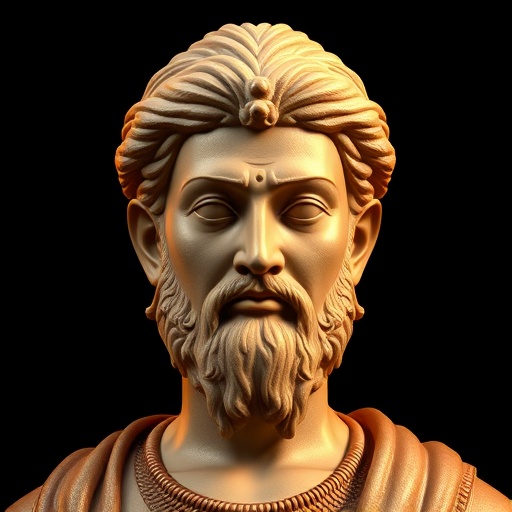
Mahavira — "One should not accumulate wealth beyond one's needs."
One should not accumulate wealth beyond one's needs.
One should not accumulate wealth beyond one's needs.
Click any product to generate a realistic preview. Up to 3 at a time.
* Initial load can take up to 90 seconds — revising the preview in another color is nearly instant.
"The greatest wisdom is to know oneself."
"Live and allow others to live. Hurt neither yourself nor others."
"The soul is pure and eternal. It is never born, nor does it ever die."
"The soul is the only thing that is blissful; everything else is sorrowful."
"The path to liberation is difficult, but it is the only path to true happiness."
24th and last Tirthankara of Jainism, whose teachings of strict ahimsa (non-violence), aparigraha (non-attachment), and karma reshaped ancient Indian religion. Closely associated with The Buddha (near-contemporary moral revolutionary, also reacting against Vedic ritualism). For an intellectual contrast, see Vedic Brahmanical ritual sacrifice, the animal-sacrifice-centered Vedic religion of his era — Mahavira's ahimsa demanded total non-violence, including not eating root vegetables that kill the plant — a maximum-distance ethical move from the Vedic priestly tradition that ritually sacrificed cattle and horses. The two cleanest poles of ancient Indian religious ethics.
Found in 1 providers: grok
1 source checked
Take only what you genuinely need to live — no more. Accumulating wealth, goods, or resources beyond real necessity breeds attachment, feeds greed, and creates moral debt. This isn't poverty as a goal, but sufficiency: define your actual needs honestly, meet them, and stop. Everything beyond that threshold is excess that corrupts character and disrupts the natural balance between people and the world they share.
Mahavira, born a Kshatriya prince, renounced his royal wealth and family at 30 to become an ascetic, ultimately owning nothing — not even clothing. He made aparigraha, non-possessiveness, one of Jainism's five central vows. This quote is essentially his autobiography: he answered the question of how much is enough by choosing the irreducible minimum and spending decades demonstrating it. The principle wasn't abstract philosophy — it was his lived identity.
Mahavira lived in 6th–5th century BCE northeastern India, during rapid urbanization of the Gangetic plains and growth of a wealthy merchant class. The dominant Vedic brahminical religion demanded costly animal sacrifices, channeling wealth toward rituals. Social stratification was sharpening. His principle of aparigraha directly countered both priestly wealth-extraction and mercantile hoarding, offering a radical alternative at a moment when accumulation was becoming the defining social force.
AI-generated insights based on extensive research and information for context. Factual errors? Email [email protected].
Your cart is empty