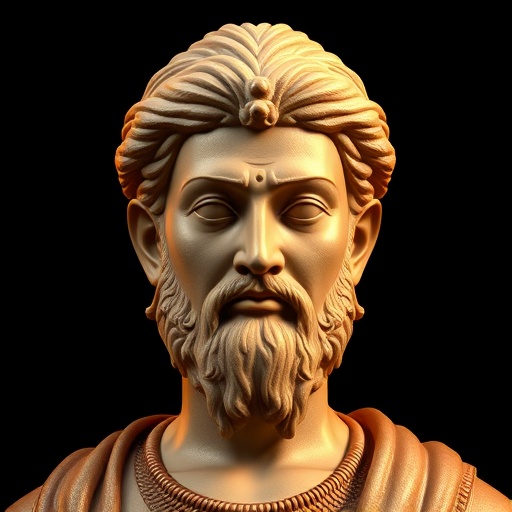
Mahavira — "The soul is pure and eternal. It is never born, nor does it ever die."
The soul is pure and eternal. It is never born, nor does it ever die.
The soul is pure and eternal. It is never born, nor does it ever die.
Click any product to generate a realistic preview. Up to 3 at a time.
* Initial load can take up to 90 seconds — revising the preview in another color is nearly instant.
"Know then that the truth is eternal, pure, and unchanging."
"Control of the senses is the highest form of self-control."
"One who has conquered himself is truly a hero."
"Do not kill. Do not lie. Do not steal. Do not be unchaste. Do not possess anything."
"The soul is entangled in the web of karma."
24th and last Tirthankara of Jainism, whose teachings of strict ahimsa (non-violence), aparigraha (non-attachment), and karma reshaped ancient Indian religion. Closely associated with The Buddha (near-contemporary moral revolutionary, also reacting against Vedic ritualism). For an intellectual contrast, see Vedic Brahmanical ritual sacrifice, the animal-sacrifice-centered Vedic religion of his era — Mahavira's ahimsa demanded total non-violence, including not eating root vegetables that kill the plant — a maximum-distance ethical move from the Vedic priestly tradition that ritually sacrificed cattle and horses. The two cleanest poles of ancient Indian religious ethics.
Found in 1 providers: grok
1 source checked
The quote expresses the Jain belief that the soul exists independently of the physical body — it has no beginning and no end. What we call birth and death are transitions of the body, not the soul itself. The soul is inherently pure, untouched by worldly corruption. Understanding this frees people from fear of death and redirects focus toward spiritual purification rather than material attachment.
Mahavira spent 12 years in rigorous ascetic practice, renouncing possessions and comfort to purify his soul and achieve liberation (moksha). His entire life was built around the conviction that the soul is eternal and perfectible through discipline. This belief also underlies his foundational principle of ahimsa — if every creature carries a pure, immortal soul, harming any being becomes a grave spiritual offense.
Mahavira lived in 6th–5th century BCE India during intense philosophical upheaval when the Shramana movement challenged Vedic Brahminical orthodoxy. Dominant religion relied on animal sacrifice and priestly ritual to appease gods. Mahavira and the Buddha both rejected this, offering paths of personal spiritual effort instead. Asserting that the soul is eternally pure — requiring no sacrifice or priestly mediation — was genuinely revolutionary for that era.
AI-generated insights based on extensive research and information for context. Factual errors? Email [email protected].
Your cart is empty