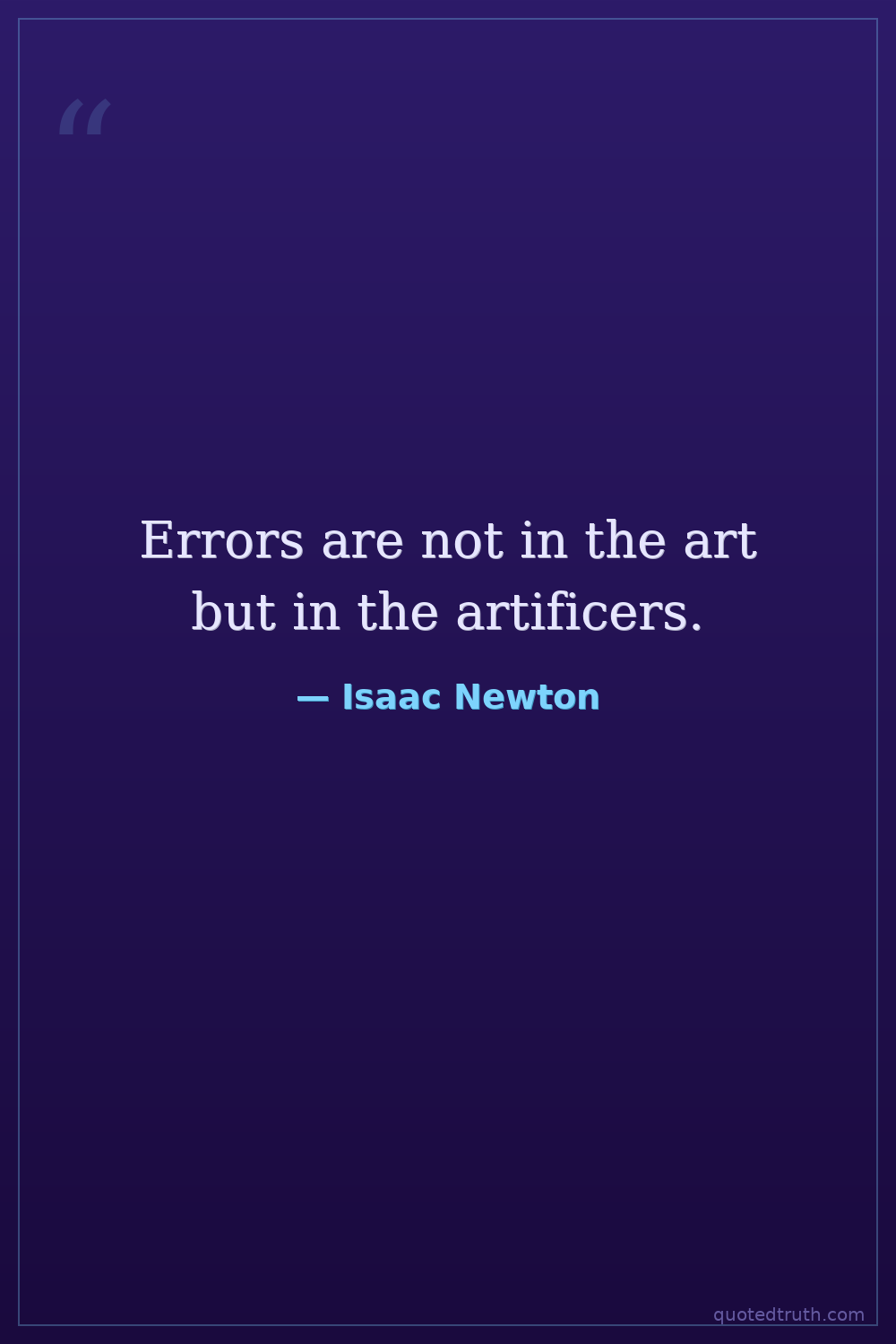
Isaac Newton — "Errors are not in the art but in the artificers."
Errors are not in the art but in the artificers.
Errors are not in the art but in the artificers.
Click any product to generate a realistic preview. Up to 3 at a time.
* Initial load can take up to 90 seconds — revising the preview in another color is nearly instant.
"I shall not mingle conjectures with certainties."
"What is it that induces a man to be a philosopher? It is not the love of truth, but the love of fame, or the love of novelty, or the love of power."
"Atheism is so senseless and odious to mankind that it never had many professors."
"Hypotheses non fingo. (I frame no hypotheses.)"
"Plato is my friend, Aristotle is my friend, but truth is more my friend."
Found in 2 providers: grok,deepseek
2 sources checked
Mistakes don't come from the discipline or method itself — they come from the people applying it. The art, meaning the craft, science, or system, is inherently sound; what goes wrong is human imperfection, carelessness, or misapplication. Don't blame the tool or field when something fails — look at the practitioner who misunderstood or misused it. Accountability belongs to the person, not the process.
Newton believed natural laws were perfect and immutable — gravity and motion operated without flaw. His fierce disputes with Leibniz, Hooke, and Flamsteed consistently centered on who had erred in calculation or method, never on whether mathematics itself was defective. His obsessive precision in the Principia reflected a core conviction that practitioners must be rigorous enough to be worthy of the discipline they claim to practice.
Newton worked during the 17th-century Scientific Revolution, when natural philosophy was separating from medieval superstition and establishing repeatable methodology. The Royal Society, founded in 1660, explicitly aimed to filter credible inquiry from charlatanism. Alchemists, astrologers, and frauds still operated alongside legitimate investigators, making the distinction between a sound method and a careless practitioner a live and urgent question that shaped how Enlightenment thinkers defined reliable knowledge.
AI-generated insights based on extensive research and information for context. Factual errors? Email [email protected].
Your cart is empty