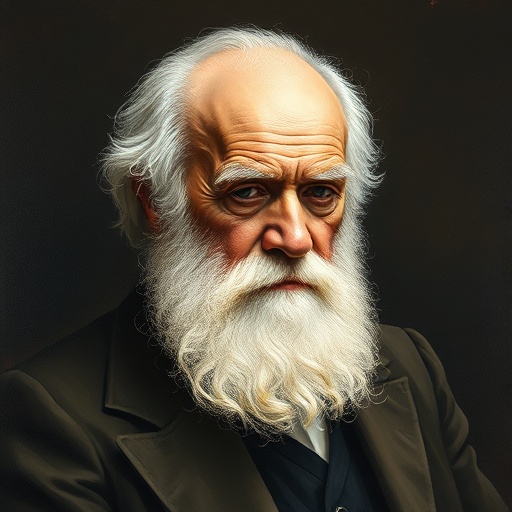
Charles Darwin — "It is not the strongest of the species that survives, nor the most intelligent t…"
It is not the strongest of the species that survives, nor the most intelligent that survives. It is the one that is most adaptable to change.
It is not the strongest of the species that survives, nor the most intelligent that survives. It is the one that is most adaptable to change.
Click any product to generate a realistic preview. Up to 3 at a time.
* Initial load can take up to 90 seconds — revising the preview in another color is nearly instant.
"I could show fight on natural selection having done and doing more for the progress of civilization than you seem inclined to admit."
"The more I see of the world, the more I am convinced of the fact that it is full of wonders."
"If the misery of the poor be caused not by the laws of nature, but by our institutions, great is our sin."
"I had no intention of writing an autobiography, but I found myself doing so."
"I hate a Barnacle as no man ever did before, not even a Sailor in a slow-sailing ship."
British naturalist whose On the Origin of Species (1859) established evolution by natural selection — the unifying theory of modern biology. Closely associated with Thomas Henry Huxley (his 'bulldog' public defender) and Alfred Russel Wallace (independent co-discoverer of natural selection). For an intellectual contrast, see William Paley, Anglican theologian and Natural Theology author (1743-1805) — Origin of Species is structurally a 400-page reply to Paley — Darwin admired Paley's watchmaker-argument as an undergraduate at Cambridge and then spent 20 years building the empirical machinery to displace him. The cleanest 'design argument vs natural selection' founding rebuttal in science.
The standard scholarly entry points to Charles Darwin's work: Janet Browne (Harvard, history of science) — Charles Darwin: Voyaging (1995) and The Power of Place (2002); Adrian Desmond (UCL, biographer) — Darwin: The Life of a Tormented Evolutionist (1991, with James Moore). These are the works graduate seminars cite when teaching Charles Darwin.
Commonly attributed to Darwin, but not found in his published works. Likely a misattribution or paraphrase.
Date: Uncertain
Power & LeadershipFound in 1 providers: grok
1 source checked
Survival belongs neither to the physically strongest nor the most intellectually gifted — it belongs to whoever can adjust when conditions shift. Strength and intelligence matter less than the capacity to recognize change and respond effectively. In any environment, biological or social, those who cling to outdated strategies perish while those who flex and evolve persist. Adaptability is the ultimate competitive advantage.
Darwin spent five years on the Beagle voyage revising his own assumptions about species as he encountered radically different ecosystems across continents. He sat on his theory of natural selection for over two decades, carefully adapting his arguments before publishing On the Origin of Species in 1859. His Galápagos finch observations showed directly how populations surviving environmental shifts were those whose traits matched new conditions — the living proof behind this idea.
Darwin published in 1859 during Britain's explosive industrial transformation, when railways, factories, and empire were reshaping society within single lifetimes. Geological discoveries like Lyell's Principles of Geology were already undermining fixed creationist timelines. The idea that nature itself was dynamic — not static and divinely arranged — was radical. His era was one of the fastest-changing periods in human history, making the concept of adaptation resonant far beyond biology.
AI-generated insights based on extensive research and information for context. Factual errors? Email [email protected].
Your cart is empty