Charles Darwin — "The more I see of the world, the more I am convinced of the fact that it is full…"
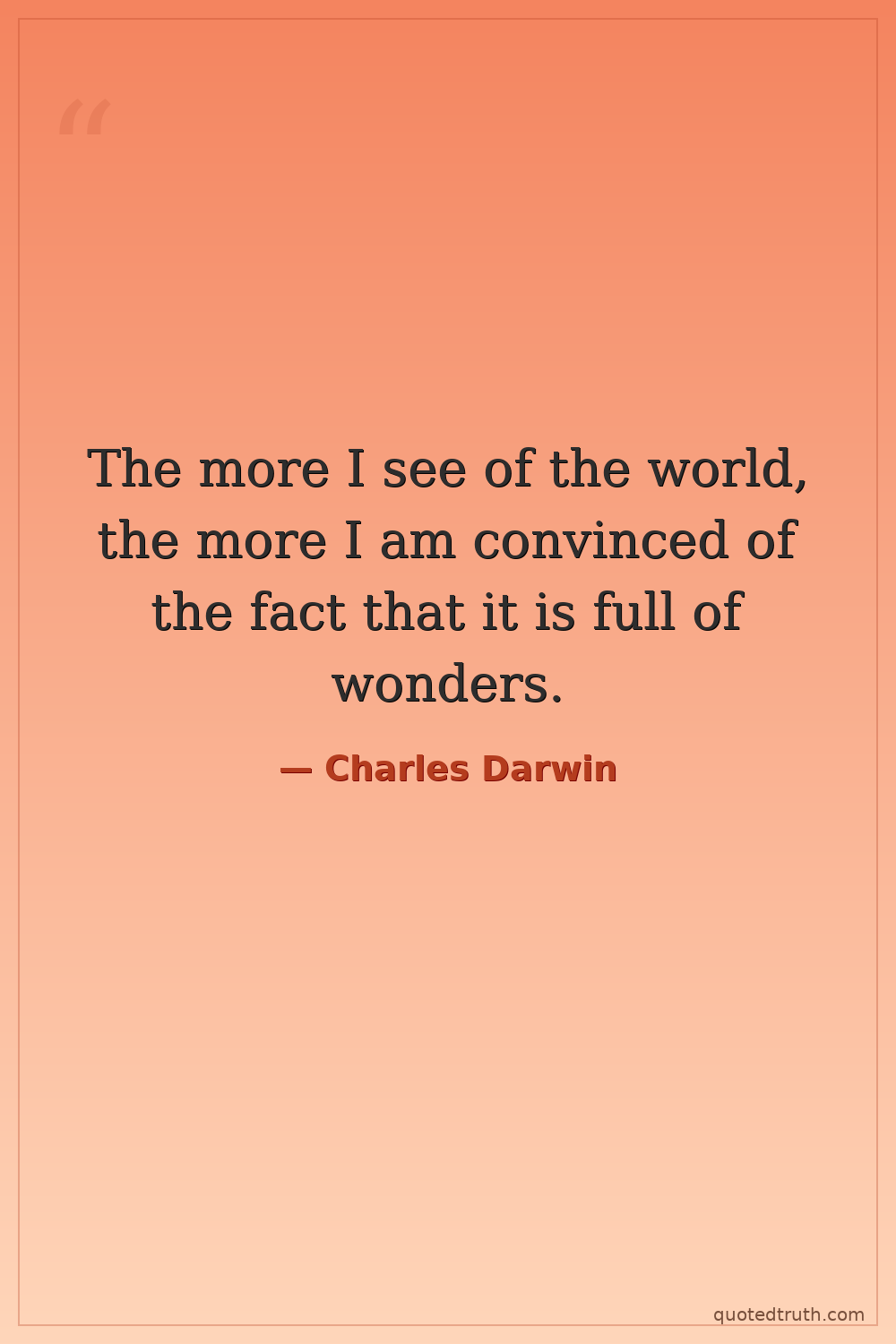
The more I see of the world, the more I am convinced of the fact that it is full of wonders.
The more I see of the world, the more I am convinced of the fact that it is full of wonders.
Click any product to generate a realistic preview. Up to 3 at a time.
* Initial load can take up to 90 seconds — revising the preview in another color is nearly instant.
"I confess I am not much interested in the future, for I am too much occupied with the present."
"The very existence of our senses, our reason, and our intellect, is a proof that these faculties were given us for some purpose."
"Looking to the world at no very distant date, what an endless number of the lower races will have been eliminated by the higher civilized races throughout the world."
"I have always maintained that, in this country, a man can do whatever he likes, provided he is a gentleman."
"But I am very poorly today and very stupid and hate everybody and everything."
British naturalist whose On the Origin of Species (1859) established evolution by natural selection — the unifying theory of modern biology. Closely associated with Thomas Henry Huxley (his 'bulldog' public defender) and Alfred Russel Wallace (independent co-discoverer of natural selection). For an intellectual contrast, see William Paley, Anglican theologian and Natural Theology author (1743-1805) — Origin of Species is structurally a 400-page reply to Paley — Darwin admired Paley's watchmaker-argument as an undergraduate at Cambridge and then spent 20 years building the empirical machinery to displace him. The cleanest 'design argument vs natural selection' founding rebuttal in science.
The standard scholarly entry points to Charles Darwin's work: Janet Browne (Harvard, history of science) — Charles Darwin: Voyaging (1995) and The Power of Place (2002); Adrian Desmond (UCL, biographer) — Darwin: The Life of a Tormented Evolutionist (1991, with James Moore). These are the works graduate seminars cite when teaching Charles Darwin.
From his 'Voyage of the Beagle', expressing his sense of wonder.
Date: 1839
Self-DeprecatingFound in 1 providers: grok
1 source checked
Seeing more of the world deepens your sense of wonder rather than satisfying it. Each new discovery reveals greater complexity, not simple answers. The more you learn, the more remarkable existence becomes — nature's patterns, creatures, and forces all point to something astonishing beneath the surface. True understanding breeds awe, not indifference. Wonder expands with knowledge, not despite it.
Darwin's five-year Beagle voyage across South America and the Galápagos exposed him to staggering biodiversity that deepened rather than dulled his curiosity. Each new species or fossil opened more questions than it closed. His painstaking work on barnacles, earthworms, and orchids — not just evolution — reveals a man who never stopped marveling. His letters consistently express astonishment at nature's ingenuity and intricate design.
Darwin lived in the Victorian era, when Western expeditions were systematically mapping the natural world for the first time at scale. Religious doctrine had long explained nature's design, but naturalists were beginning to challenge those frameworks. Public fascination with exotic specimens and distant lands ran high — this was an age of both wonder and intellectual upheaval, as science reshaped humanity's understanding of its place in nature.
AI-generated insights based on extensive research and information for context. Factual errors? Email [email protected].
Your cart is empty