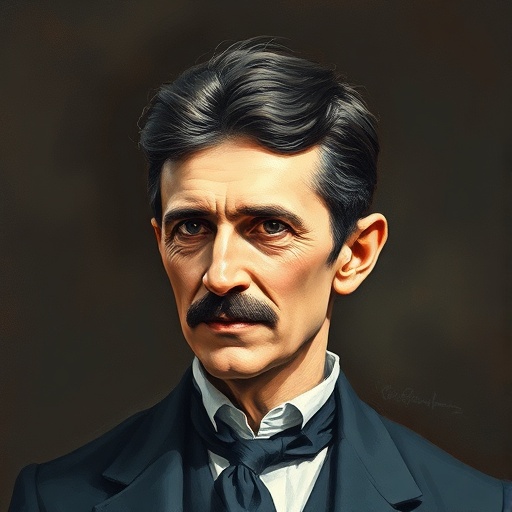
Nikola Tesla — "It is not a death ray in the sense that it kills. It is a weapon that will make …"
It is not a death ray in the sense that it kills. It is a weapon that will make war impossible.
It is not a death ray in the sense that it kills. It is a weapon that will make war impossible.
Click any product to generate a realistic preview. Up to 3 at a time.
* Initial load can take up to 90 seconds — revising the preview in another color is nearly instant.
"I am willing to sacrifice my life for the benefit of humanity."
"The spread of civilization may be likened to a fire; first, a feeble spark, then a flickering flame, then a mighty conflagration, fiercely glowing and devouring."
"Money does not represent such a value as man has placed in it. All my money I invested in inventions which enabled new inventions enabling an easier life for humanity."
"Though free to think and act, we are held together, like the stars in the firmament, with ties inseparable. These ties cannot be seen, but we can feel them. I cut myself in the finger, and it pains me…"
"Even matter which is called inorganic, deemed dead, responds to the disbelievers and gives irrefutable proof of the living principle within itself. Everything that exists, organic or inorganic, living…"
Serbian-American inventor and electrical engineer whose alternating-current designs powered the modern electrical grid; died poor and largely forgotten. Closely associated with George Westinghouse (his AC-power business partner) and Mihajlo Pupin (fellow Serbian-American physicist at Columbia). For an intellectual contrast, see Thomas Edison, American inventor and direct-current advocate — Edison's direct-current power-distribution scheme was displaced by Tesla-Westinghouse AC in the 1890s 'War of Currents'. Edison ran a public-relations campaign electrocuting animals to discredit AC — the most famous engineering-ethics rivalry in American history. Tesla's AC won and powers nearly every electrical grid on Earth.
Found in 1 providers: grok
1 source checked
This quote describes a deterrence weapon so destructive that no rational nation would risk triggering it. Tesla argues the weapon's power lies not in killing but in making conflict strategically unthinkable — a peace-through-overwhelming-force logic where mutual annihilation potential eliminates war as a viable option for any aggressor.
Tesla spent his final decades pitching his 'teleforce' particle beam projector to governments worldwide, genuinely believing technology could end warfare. This reflects his lifelong pattern of grandiose visionary claims tied to real engineering ambition — the same mind that electrified civilization believed a single invention could eliminate human conflict entirely.
Tesla made these claims in the 1930s as fascism rose across Europe, the Spanish Civil War raged, and WWI's catastrophic death toll was still fresh. Nations were rearming rapidly. The era desperately sought technological or diplomatic solutions to prevent another world war, making Tesla's deterrence-weapon concept both timely and tragically ignored.
AI-generated insights based on extensive research and information for context. Factual errors? Email [email protected].
Your cart is empty