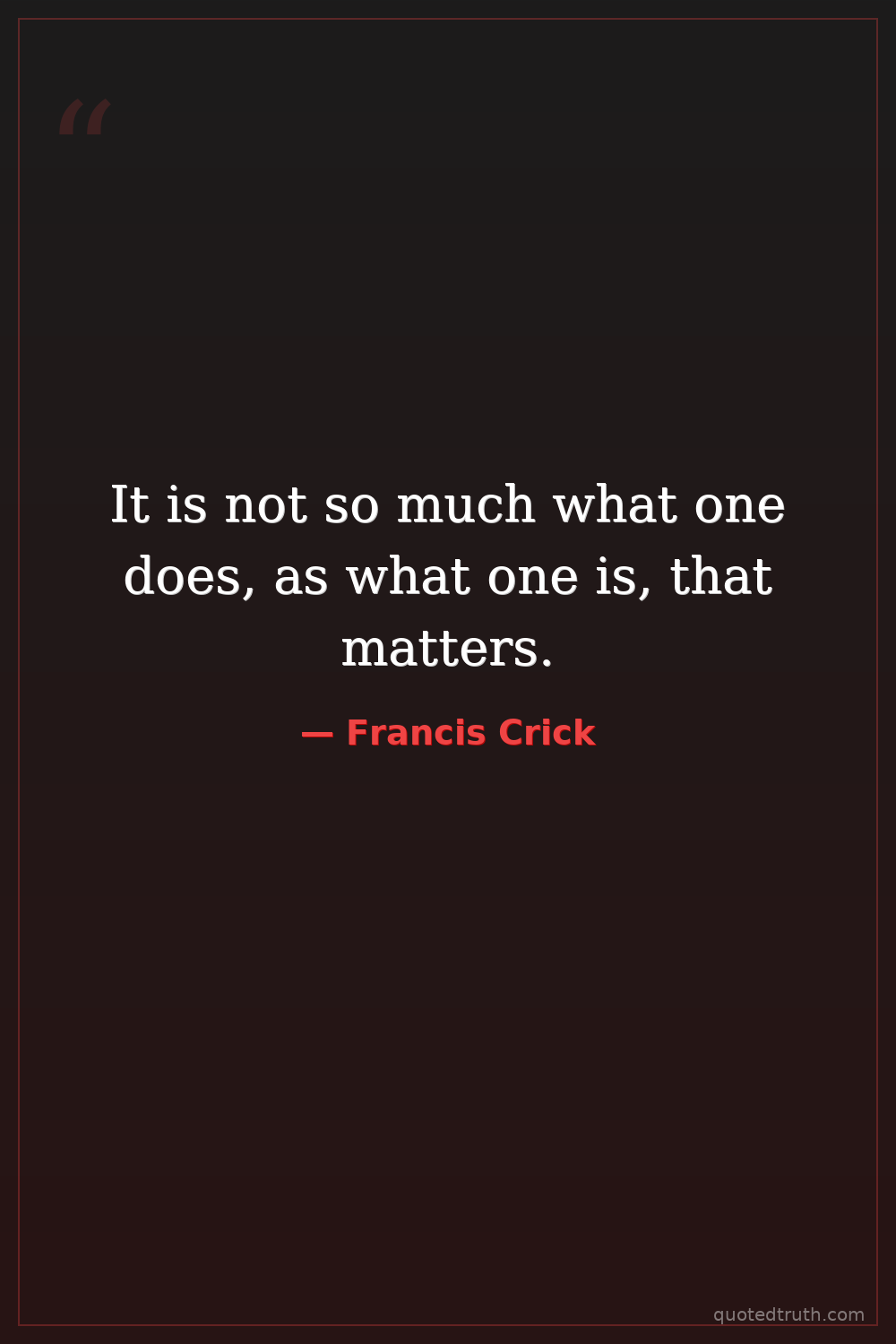
Francis Crick — "It is not so much what one does, as what one is, that matters."
It is not so much what one does, as what one is, that matters.
It is not so much what one does, as what one is, that matters.
Click any product to generate a realistic preview. Up to 3 at a time.
* Initial load can take up to 90 seconds — revising the preview in another color is nearly instant.
"We were searching for a structure so simple and beautiful that it had to be true."
"A theory that fits all the facts is bound to be wrong, as some of the facts will be wrong."
"The greatest obstacle to discovery is not ignorance, but the illusion of knowledge."
"No newborn child has a soul."
"You, your joys and your sorrows, your memories and your ambitions, your sense of personal identity and free will, are in fact no more than the behavior of a vast assembly of nerve cells and their asso…"
Found in 1 providers: grok
1 source checked
Your character and inner identity matter more than your accomplishments or activities. The person you genuinely are—your values, integrity, curiosity, and convictions—carries more weight than any specific deed or career achievement. Actions can be imitated, faked, or judged by outcomes alone, but who you are at your core shapes everything else and represents the truer measure of a life. Being authentic outweighs merely doing impressive things.
Crick co-discovered DNA's double helix in 1953, yet he repeatedly insisted curiosity and intellectual honesty mattered more than prizes. He resigned from Churchill College over a chapel dispute, abandoned physics for biology mid-career, and later pivoted again to consciousness research at the Salk Institute. A militant atheist and freethinker, Crick valued the questioning mind itself over credentials, awards, or the institutional roles he repeatedly walked away from when they conflicted with his identity.
Crick worked through the postwar molecular biology revolution (1950s–2000s), an era obsessed with credentials, Nobel Prizes, and institutional prestige as science industrialized. The Cold War poured money into research, creating careerist scientists chasing grants and citations. Simultaneously, the 1960s counterculture questioned achievement-based identity, and existentialist thought emphasized authentic being over doing. Crick's remark cuts against the publish-or-perish machine that his own DNA discovery helped accelerate, defending inner character against an increasingly metrics-driven scientific culture.
AI-generated insights based on extensive research and information for context. Factual errors? Email [email protected].
Your cart is empty