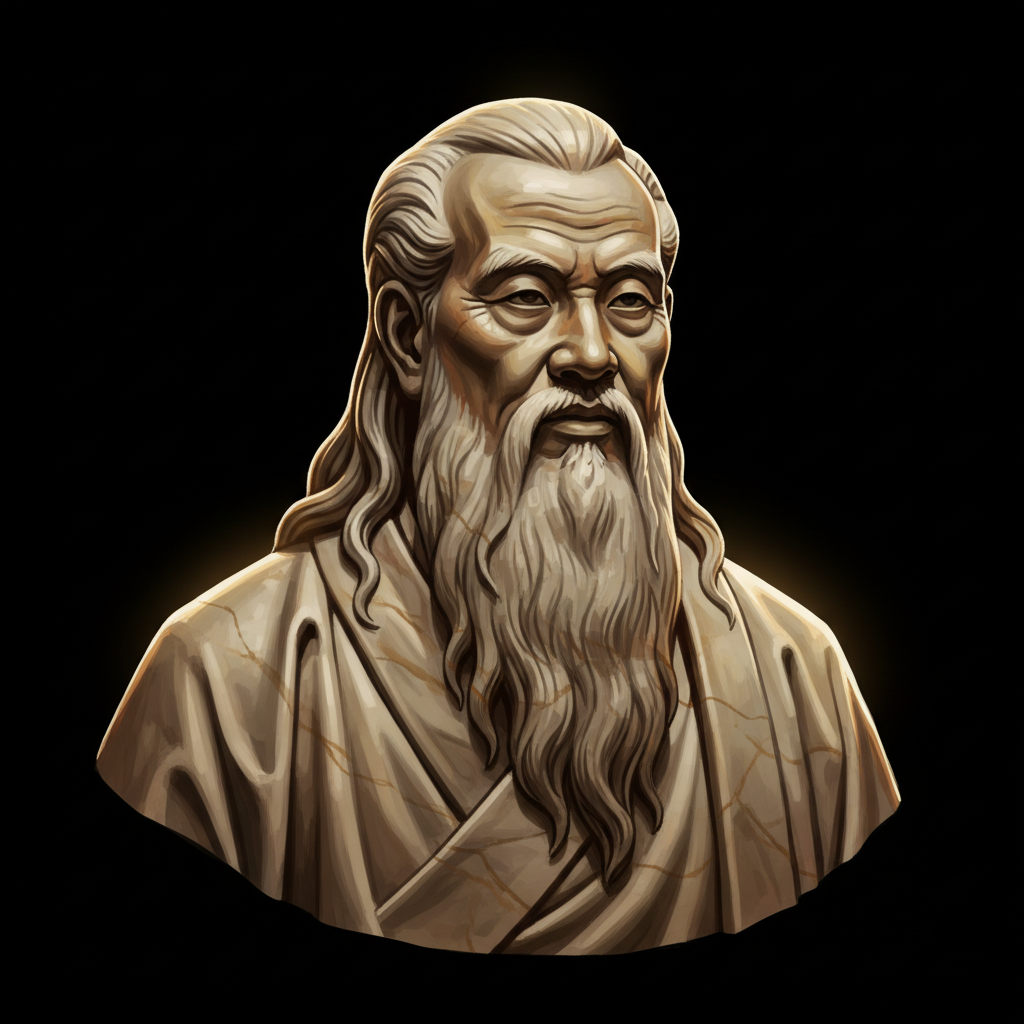
Laozi — "Those who know do not talk. Those who talk do not know."
Those who know do not talk. Those who talk do not know.
Those who know do not talk. Those who talk do not know.
Click any product to generate a realistic preview. Up to 3 at a time.
* Initial load can take up to 90 seconds — revising the preview in another color is nearly instant.
"Empty your mind of all thoughts. Let your heart be at peace. Watch the turmoil of the world, but let your serenity remain intact."
"Use justice to rule a country. Use surprise to wage war. Use non-action to govern the world."
"The wise man's food is that which nourishes him; the fool's food is that which gratifies him."
"The best way to manage is to manage very little."
"The highest good is like water. It nourishes all things without trying to."
Reputed founder of Taoism and author of the Tao Te Ching, whose wu wei (effortless action) shaped East Asian philosophy. Closely associated with Zhuangzi (later Taoist who extended Laozi's framework). For an intellectual contrast, see Confucius, near-contemporary Chinese sage of social ritual and duty — Confucius systematized social order through ritual and hierarchy; Laozi argued that all such systems were the disease, not the cure — the two founding poles of Chinese moral philosophy.
Found in 1 providers: gemini
1 source checked
Real understanding shows itself through silence, restraint, and action rather than loud proclamation. People who genuinely grasp a subject feel little need to broadcast their knowledge, because the deepest truths resist tidy verbal packaging. Conversely, those who chatter confidently often reveal shallow comprehension, mistaking vocabulary for wisdom. The saying warns against equating fluency with insight and invites humility: listen more, speak less, and trust that meaningful knowing operates beneath words.
Laozi, the semi-legendary founder of Taoism, reportedly served as an archivist in the Zhou royal court before withdrawing from public life, disillusioned with political noise. Legend says he composed the Tao Te Ching only when a border guard begged him to, then vanished westward. This quote mirrors his preference for quiet observation over doctrine, his distrust of clever rhetoric, and his core teaching that the Tao which can be spoken is not the eternal Tao.
Laozi lived during China's late Zhou dynasty, an age of collapsing feudal authority and endless warfare later called the Spring and Autumn period. Rival states competed through diplomacy, scholarly persuasion, and Confucian moralizing, flooding courts with advisors, rhetoricians, and competing philosophies. Against that backdrop of verbal posturing and political theater, Laozi's praise of silence was quietly radical, offering a counterweight to the era's faith in argument, ritual prescription, and the assumption that eloquence equaled virtue or competence.
AI-generated insights based on extensive research and information for context. Factual errors? Email [email protected].
Your cart is empty