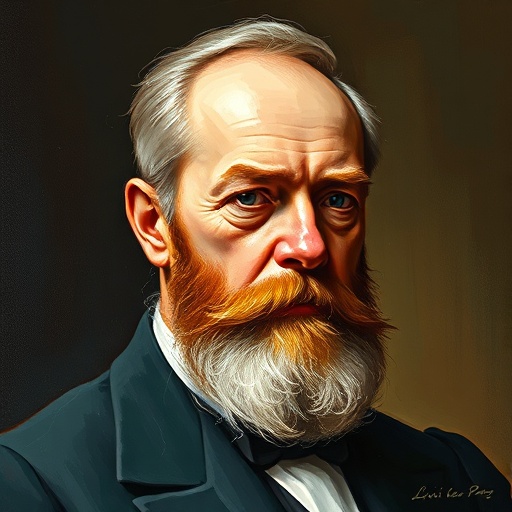
Louis Pasteur — "To him who devotes his life to science, nothing can be more important than the s…"
To him who devotes his life to science, nothing can be more important than the study of its history.
To him who devotes his life to science, nothing can be more important than the study of its history.
Click any product to generate a realistic preview. Up to 3 at a time.
* Initial load can take up to 90 seconds — revising the preview in another color is nearly instant.
"I am utterly convinced that there is a germ for every disease."
"The Greeks understood the mysterious power of the hidden side of things."
"There are no such things as applied sciences, only applications of science."
"We must not forget that science, like all human activities, has its limits."
"A bottle of wine contains more philosophy than all the books in the world."
Attributed, emphasizing the importance of historical context in scientific endeavor.
Date: Late 19th Century (approx.)
EducationalFound in 1 providers: grok
1 source checked
Anyone pursuing a scientific career should treat the history of their field as essential, not optional. Understanding how past discoveries unfolded, which hypotheses failed, and how methods matured prevents repeating old mistakes and sharpens judgment about what counts as real progress. Without that context, a researcher drifts, mistaking novelty for insight. Knowing the lineage of ideas is what turns a technician into a thinker capable of extending the tradition.
Pasteur built germ theory by dismantling spontaneous generation, a doctrine inherited from centuries of prior argument. His swan-neck flask experiments only made sense as replies to Needham, Spallanzani, and Pouchet. Pasteurization, vaccination for rabies and anthrax, and fermentation chemistry all grew from close reading of predecessors' errors. He repeatedly framed his breakthroughs as corrections to historical claims, showing that his own method was inseparable from tracing where earlier naturalists went wrong.
The late nineteenth century was the moment science professionalized: universities built laboratories, journals multiplied, and disciplines separated from natural philosophy. Debates over spontaneous generation, miasma versus contagion, and Darwinian descent forced scientists to argue explicitly against deep historical positions. National academies were compiling disciplinary histories, and figures like Pasteur gave public lectures positioning current work inside that arc. Treating history as part of scientific training fit an era self-consciously defining what science itself was.
AI-generated insights based on extensive research and information for context. Factual errors? Email [email protected].
Your cart is empty