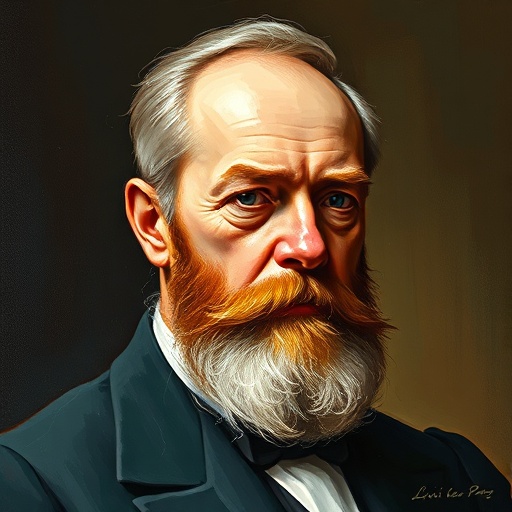
Louis Pasteur — "Happy is the man who has a vocation which he can follow with passion."
Happy is the man who has a vocation which he can follow with passion.
Happy is the man who has a vocation which he can follow with passion.
Click any product to generate a realistic preview. Up to 3 at a time.
* Initial load can take up to 90 seconds — revising the preview in another color is nearly instant.
"The more I learn, the more I realize how much I don't know."
"You have not succeeded in your experiments, that is all there is to it."
"Do not let yourself be discouraged by the difficulties of research, and do not be afraid of a little suffering, for it is in this way that the truth will be revealed."
"I have been for the past three years studying a disease which is called hydrophobia, or rabies. It is a disease which I believe to be caused by a microbe."
"Posterity will one day laugh at the sublime foolishness of the modern materialistic philosophy."
Attributed, reflecting his own dedication to his work.
Date: Late 19th Century (approx.)
InspirationalFound in 1 providers: grok
1 source checked
True fulfillment comes when your work aligns with a calling you genuinely love. Finding a career that stirs real enthusiasm transforms labor from a burden into a source of daily joy. The luckiest people are not those who earn the most or gain prestige, but those whose profession matches their inner drive. When passion and occupation merge, effort feels natural and life gains purposeful meaning.
Pasteur embodied this ideal, devoting relentless hours to microbiology despite personal tragedy, including losing three daughters to infectious diseases. His passion fueled breakthroughs in fermentation, vaccination, and pasteurization. Even after a stroke partially paralyzed him at 46, he kept researching rabies vaccines. His life in Parisian laboratories was not a job but a consuming mission to conquer invisible killers, making this reflection deeply autobiographical.
Nineteenth-century France was transforming through industrial revolution, scientific professionalization, and public health crises. Cholera, rabies, and anthrax devastated populations, while Romantic ideals celebrated passionate individual genius. Universities were formalizing science as a respected vocation rather than gentlemanly hobby. Pasteur worked during Napoleon III's Second Empire and the Third Republic, when France sought scientific prestige to rival Germany, making devoted researchers like him national heroes.
AI-generated insights based on extensive research and information for context. Factual errors? Email [email protected].
Your cart is empty