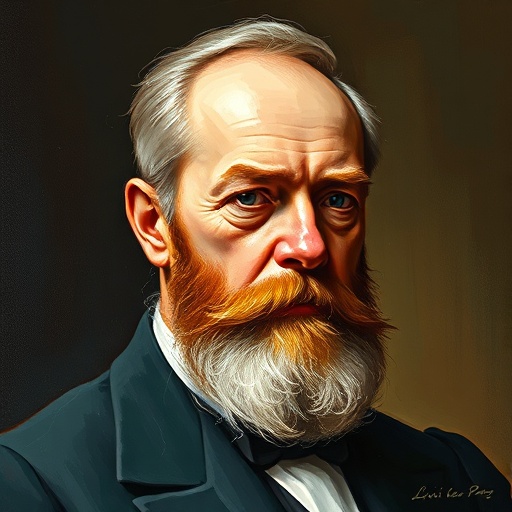
Louis Pasteur — "You have not succeeded in your experiments, that is all there is to it."
You have not succeeded in your experiments, that is all there is to it.
You have not succeeded in your experiments, that is all there is to it.
Click any product to generate a realistic preview. Up to 3 at a time.
* Initial load can take up to 90 seconds — revising the preview in another color is nearly instant.
"I am utterly convinced that there is a germ for every disease."
"Do not let yourself be tainted with a barren skepticism."
"A bottle of wine contains more philosophy than all the books in the world."
"The true character of a man is revealed in his actions, not in his words."
"Science knows no country, because knowledge belongs to humanity, and is the torch which illuminates the world. Science is the highest embodiment of the patriotism of nations."
A very blunt and straightforward assessment of failure, almost comically dismissive.
Date: 19th century (approximate)
GeneralFound in 1 providers: gemini
1 source checked
Failure in an experiment is simply that—a failure. It does not mean the underlying idea is wrong, the scientist is incompetent, or the goal is unreachable. It is a single data point, a setback to analyze and learn from, not a verdict on your worth or your theory. Keep your ego out of the result, refine your method, and try again until the evidence speaks clearly.
Pasteur spent years on painstaking trials with silkworms, anthrax, and rabies, enduring repeated failures before breakthroughs. His 1885 rabies vaccine followed countless dead rabbits and near-disasters. He famously said chance favors the prepared mind, and he modeled resilience: a stroke at 46 left him partially paralyzed, yet he continued experimenting. This line captures his insistence that setbacks are methodological, not existential—a lesson forged in his own laboratory grind.
In mid-to-late 19th-century France, science was professionalizing and contested. Pasteur battled spontaneous-generation believers, skeptical physicians resisting germ theory, and rival chemists. Public demonstrations—like the 1881 Pouilly-le-Fort anthrax trial—risked career-ending humiliation. Industrial stakes were huge: wine, beer, silk, and livestock economies depended on his results. In that climate of scrutiny and high-stakes public experiments, separating a failed trial from a failed idea was essential to keep advancing the emerging germ-theory revolution.
AI-generated insights based on extensive research and information for context. Factual errors? Email [email protected].
Your cart is empty