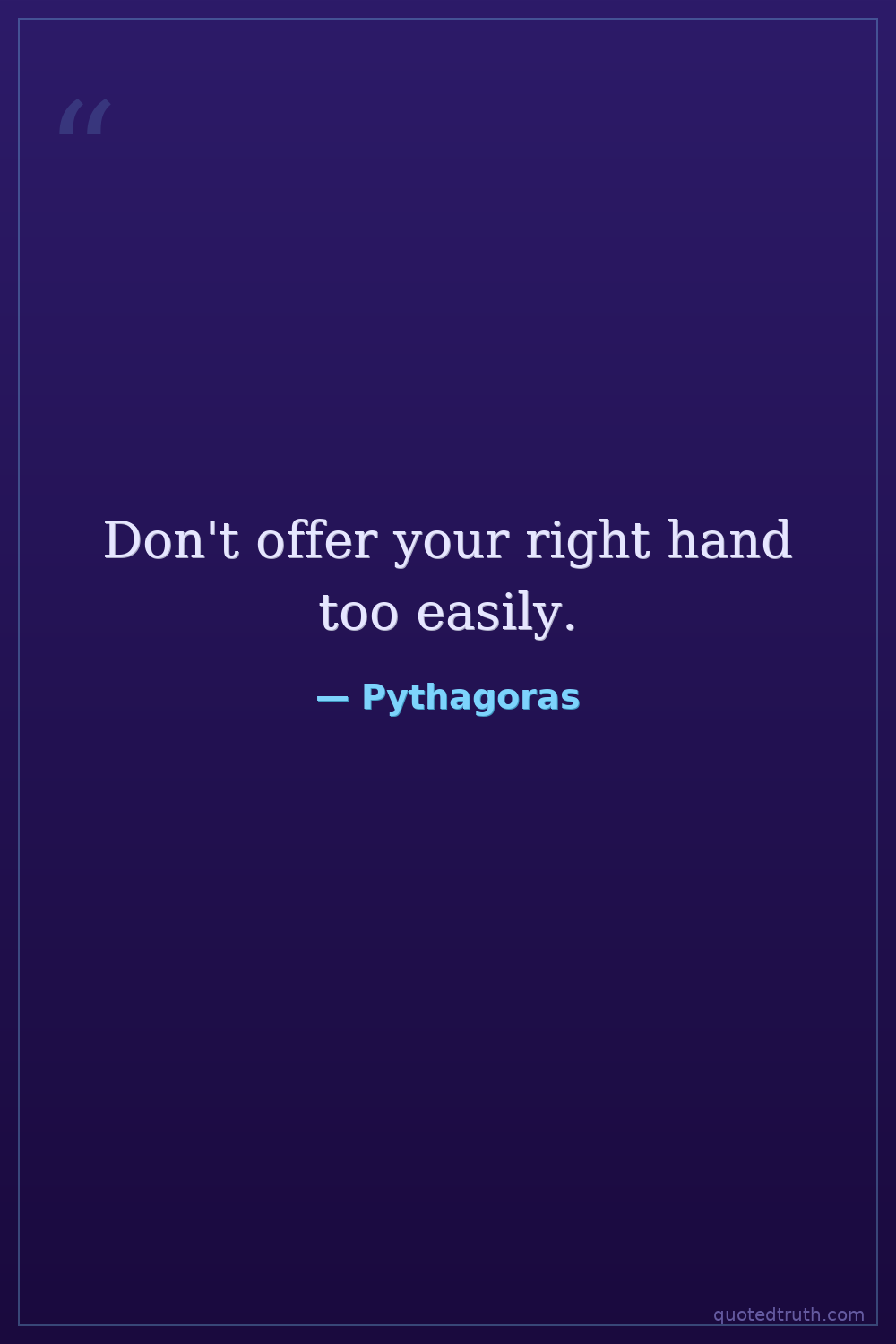
Pythagoras — "Don't offer your right hand too easily."
Don't offer your right hand too easily.
Don't offer your right hand too easily.
Click any product to generate a realistic preview. Up to 3 at a time.
* Initial load can take up to 90 seconds — revising the preview in another color is nearly instant.
"A blow from your friend is better than a kiss from your enemy."
"Neither be covetous nor stingy; a due measure is excellent in these things."
"Learn to be silent. Let your quiet mind listen and absorb."
"No one is free who has not obtained the empire of himself."
"A fool is known by his speech, and a wise man by silence."
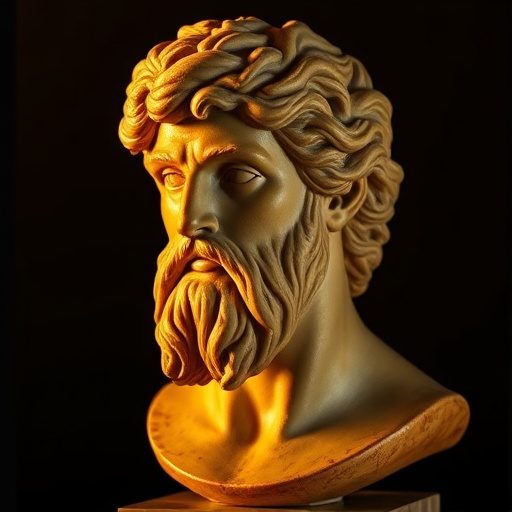
Greek philosopher and mathematician whose school in Croton combined geometry (the Pythagorean theorem), number-mysticism, and a religious-vegetarian way of life. Closely associated with Thales of Miletus (earlier pre-Socratic and the first philosopher). For an intellectual contrast, see Heraclitus, pre-Socratic Greek philosopher of flux — Heraclitus called Pythagoras 'the chief of swindlers' — among the founding insults of the philosophical-rivalry tradition. Their 'all is flux' vs 'all is number' poles still organize the philosophy of mathematics today (Platonist vs anti-realist).
A Pythagorean 'Symbol', interpreted as being mindful before giving advice or not helping the unworthy.
Date: c. 570-495 BCE (interpreted later)
WisdomFound in 1 providers: gemini
1 source checked
Be careful about who you commit to, trust, or form alliances with. The right hand historically sealed oaths and handshakes — binding agreements. This warns against rushing into promises, friendships, or loyalties before you truly know someone. Guard your word and your trust as finite, valuable resources. Think before you pledge yourself, because not everyone deserves that level of confidence from you.
Pythagoras founded a highly secretive philosophical brotherhood with a multi-year probationary period before full membership was granted. He was famously selective about who received his teachings, withholding mathematical and mystical knowledge from the unworthy. His entire school was built on earned trust and rigorous vetting. This aphorism mirrors his lived practice: commitment was sacred, not casual, and his community enforced it through silence vows and tiered initiation.
In ancient Greece around 570–495 BCE, extending your right hand was a ritualized oath gesture — sealing contracts, alliances, and guest-friendships that carried near-sacred legal weight. Verbal pledges before witnesses were fully binding. Greek city-states rose and fell on betrayed alliances, and political life was saturated with shifting loyalties. Against this backdrop, Pythagoras's caution was both practical political wisdom and philosophical discipline about integrity.
AI-generated insights based on extensive research and information for context. Factual errors? Email [email protected].
Your cart is empty