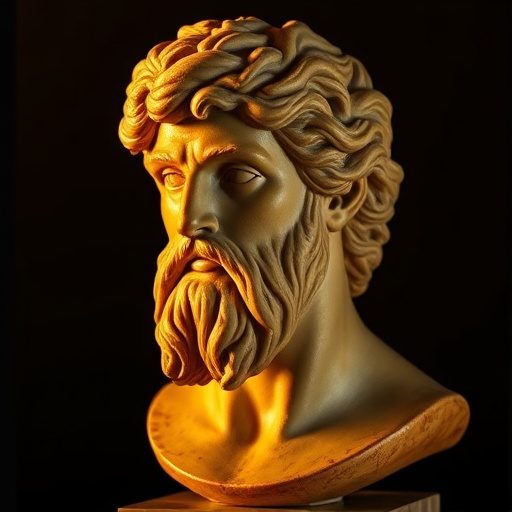
Pythagoras — "Abstain from animals."
Abstain from animals.
Abstain from animals.
Click any product to generate a realistic preview. Up to 3 at a time.
* Initial load can take up to 90 seconds — revising the preview in another color is nearly instant.
"Don't wipe up a mess with a torch."
"The wind is blowing. Worship the sound."
"Do not offer the right hand to everyone."
"Numbers rule the universe."
"Eat not the brain."
Greek philosopher and mathematician whose school in Croton combined geometry (the Pythagorean theorem), number-mysticism, and a religious-vegetarian way of life. Closely associated with Thales of Miletus (earlier pre-Socratic and the first philosopher). For an intellectual contrast, see Heraclitus, pre-Socratic Greek philosopher of flux — Heraclitus called Pythagoras 'the chief of swindlers' — among the founding insults of the philosophical-rivalry tradition. Their 'all is flux' vs 'all is number' poles still organize the philosophy of mathematics today (Platonist vs anti-realist).
A core tenet of Pythagoreanism, linked to the belief in metempsychosis (transmigration of souls).
Date: c. 570-495 BCE
Nature & WorldFound in 1 providers: gemini
1 source checked
Don't eat or harm animals. Live without killing or consuming them. The directive treats animals as beings with moral standing, not resources. It calls for deliberate restraint in diet and lifestyle, arguing that a principled life requires drawing a firm line against taking animal life for food, sacrifice, or convenience. Simple, absolute, and demanding in its scope.
Pythagoras founded a religious brotherhood at Croton that practiced strict vegetarianism rooted in his belief in metempsychosis — the transmigration of souls between humans and animals. Eating meat could mean consuming a reincarnated human soul. His community followed rigid dietary codes; this wasn't casual preference but doctrine. His mathematics and his ethics were unified: both sought underlying order and purity beneath surface appearances.
In 6th-century BCE Greece, animal sacrifice was the backbone of civic and religious life. Killing animals at temple altars was how citizens honored gods, sealed political events, and shared communal meals. Pythagoras's prohibition was radical defiance of this norm — rejecting the sacrificial economy entirely. It aligned him with Eastern influences, possibly Orphic or Indian traditions, distinguishing his sect sharply from mainstream Greek religion and politics.
AI-generated insights based on extensive research and information for context. Factual errors? Email [email protected].
Your cart is empty