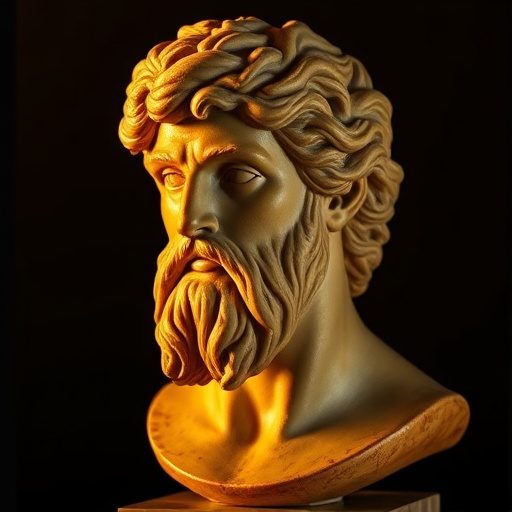
Pythagoras — "Do not offer the right hand to everyone."
Do not offer the right hand to everyone.
Do not offer the right hand to everyone.
Click any product to generate a realistic preview. Up to 3 at a time.
* Initial load can take up to 90 seconds — revising the preview in another color is nearly instant.
"Wisdom thoroughly learned will never be forgotten."
"The wind is blowing. Worship the sound."
"Eat not the brain."
"Abstain from beans."
"Numbers rule the universe."
Greek philosopher and mathematician whose school in Croton combined geometry (the Pythagorean theorem), number-mysticism, and a religious-vegetarian way of life. Closely associated with Thales of Miletus (earlier pre-Socratic and the first philosopher). For an intellectual contrast, see Heraclitus, pre-Socratic Greek philosopher of flux — Heraclitus called Pythagoras 'the chief of swindlers' — among the founding insults of the philosophical-rivalry tradition. Their 'all is flux' vs 'all is number' poles still organize the philosophy of mathematics today (Platonist vs anti-realist).
A 'symbol,' possibly advising caution in choosing friends or allies.
Date: c. 570 – c. 495 BC
ShockingFound in 1 providers: grok
1 source checked
Be selective about whom you trust and with whom you form close bonds. Offering the right hand was a gesture of friendship, alliance, and good faith, so the saying warns against extending that kind of commitment indiscriminately. Reserve genuine partnership for people who have proven their character. Casual or premature trust exposes you to betrayal, manipulation, and obligations to those who do not share your values or standards.
Pythagoras ran a tightly guarded brotherhood in Croton where initiates endured years of silence, vegetarian discipline, and vetting before gaining access to inner teachings on number, harmony, and soul. Membership was earned, not offered. This saying mirrors that gatekeeping ethic: the master who demanded a five-year probationary silence naturally warned disciples against extending fellowship casually, since his mathematical and spiritual doctrines depended on the loyalty and moral caliber of those admitted.
In sixth-century BCE Magna Graecia, the clasped right hand sealed guest-friendship, political alliances, and oaths in a world without contracts or police. Croton was riven by aristocratic factions, and Pythagoras's brotherhood wielded real political power until rival mobs burned their meeting house. Choosing allies carefully was survival, not etiquette. Greek city-states ran on personal loyalty networks, so a misplaced handshake could drag a family into another clan's feud, debts, or exile.
AI-generated insights based on extensive research and information for context. Factual errors? Email [email protected].
Your cart is empty