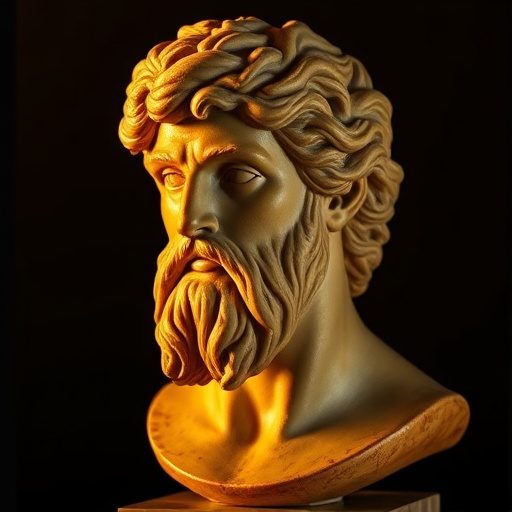
Pythagoras — "Eat not the brain."
Eat not the brain.
Eat not the brain.
Click any product to generate a realistic preview. Up to 3 at a time.
* Initial load can take up to 90 seconds — revising the preview in another color is nearly instant.
"Don't sit on a bushel."
"Wisdom thoroughly learned will never be forgotten."
"The wind is blowing. Worship the sound."
"The most difficult thing in life is to know yourself."
"Don't piss or stand on your cut nails and hair."
Greek philosopher and mathematician whose school in Croton combined geometry (the Pythagorean theorem), number-mysticism, and a religious-vegetarian way of life. Closely associated with Thales of Miletus (earlier pre-Socratic and the first philosopher). For an intellectual contrast, see Heraclitus, pre-Socratic Greek philosopher of flux — Heraclitus called Pythagoras 'the chief of swindlers' — among the founding insults of the philosophical-rivalry tradition. Their 'all is flux' vs 'all is number' poles still organize the philosophy of mathematics today (Platonist vs anti-realist).
A dietary prohibition among Pythagoreans, possibly with a symbolic meaning.
Date: c. 570-495 BCE
Nature & WorldFound in 1 providers: gemini
1 source checked
Do not consume brain tissue — from animals or any creature. Beyond the literal, this warns against treating the seat of thought and reason as mere food. For Pythagoreans, who believed souls migrate between bodies after death, eating an animal's brain risked consuming what once housed a human mind. More broadly it expresses reverence for rationality itself: the capacity for reason is sacred and should not be devoured or destroyed.
Pythagoras founded a brotherhood bound by strict dietary and behavioral rules called akousmata. He taught metempsychosis — that human souls reincarnate into animals — making meat consumption spiritually fraught. His entire system elevated reason and mathematics as pathways to divine truth. A prohibition against eating brains honors both beliefs simultaneously: reverence for animal life potentially harboring human souls, and treatment of the rational mind as something too sacred to be consumed like ordinary food.
In 6th–5th century BCE Greece, the brain's function was still philosophically contested — Alcmaeon of Croton, a Pythagorean, was among the first to identify it as the seat of perception and thought, revolutionary when most attributed consciousness to the heart. Mystery cults flourished with purity codes governing diet and conduct. Pythagorean communities stood at the crossroads of religion and early science, their dietary prohibitions encoding both spiritual fear and emerging philosophical principle about the body and soul.
AI-generated insights based on extensive research and information for context. Factual errors? Email [email protected].
Your cart is empty