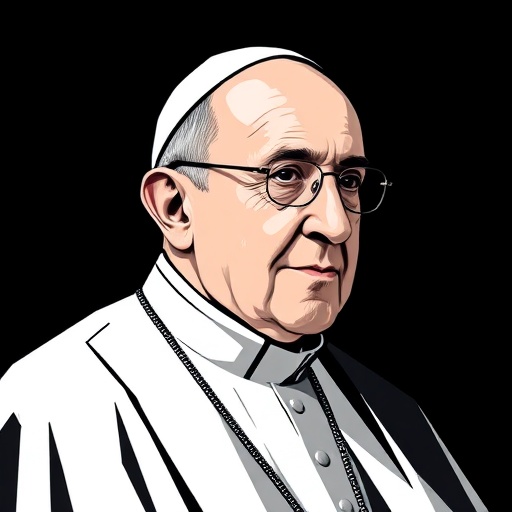
Pope Francis — "A Christian who is not a revolutionary is not a Christian."
A Christian who is not a revolutionary is not a Christian.
A Christian who is not a revolutionary is not a Christian.
Click any product to generate a realistic preview. Up to 3 at a time.
* Initial load can take up to 90 seconds — revising the preview in another color is nearly instant.
"Priests who are rigid are sick. They are sick inside."
"The Roman Curia is the leprosy of the papacy."
"Please, do not let yourselves be robbed of hope!"
"The Church is not a supermarket."
"The Lord has redeemed all of us, all of us, with the Blood of Christ: all of us, not just Catholics. Everyone!"
First Latin American and Jesuit pope (2013-), who has steered the Catholic Church toward pastoral inclusion on LGBTQ pastoral care, divorced Catholics, and climate. Closely associated with Pope John XXIII (the Vatican II reformer pope) and Cardinal Walter Kasper (his theological ally on pastoral reform). For an intellectual contrast, see Cardinal Raymond Burke, American traditionalist cardinal, former head of the Vatican Apostolic Signatura — Burke is the public face of Catholic traditionalism that views Francis's pastoral approach as doctrinally dangerous — he has formally challenged Amoris Laetitia and other Francis reforms.
Found in 1 providers: deepseek
1 source checked
Authentic Christian faith demands active, transformative engagement with injustice — not passive acceptance of the status quo. To truly follow Christ means challenging oppressive systems, championing the poor, and working to fundamentally reshape conditions that deny human dignity. Comfort, conformity, and silence are incompatible with the Gospel's radical demands. A faith that leaves the world unchanged has missed its own core calling.
Jorge Mario Bergoglio grew up in Buenos Aires amid stark inequality and Latin American liberation theology, which demanded structural justice for the poor. As a Jesuit — an order defined by rigorous social engagement — he chose the name Francis, invoking radical poverty. His papacy relentlessly challenged capitalism's excesses, defended migrants, condemned inequality, and reformed Vatican institutions, embodying the conviction that faith without transformative action is hollow.
Pope Francis's papacy began in 2013 amid escalating global inequality, mass migration crises, the Syrian refugee emergency, and rising authoritarian populism. Climate collapse threatened the world's poorest. Latin American liberation theology — long suppressed — saw renewed relevance. Within the Church, sex abuse scandals demanded radical accountability. Against this backdrop, calling Christianity revolutionary reframed faith as demanding systemic change, not individual piety in isolation from structural injustice.
AI-generated insights based on extensive research and information for context. Factual errors? Email [email protected].
Your cart is empty