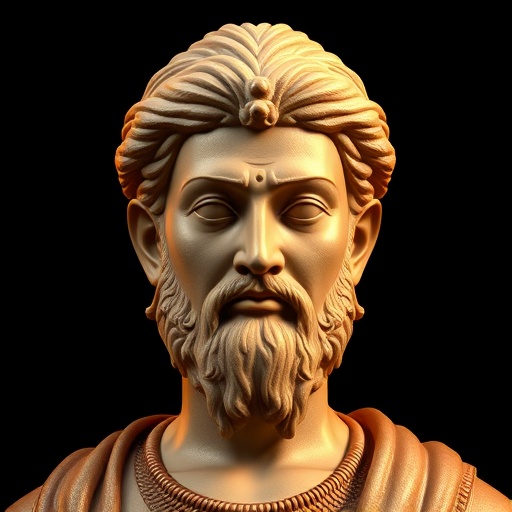
Mahavira — "Kill no living thing."
Kill no living thing.
Kill no living thing.
Click any product to generate a realistic preview. Up to 3 at a time.
* Initial load can take up to 90 seconds — revising the preview in another color is nearly instant.
"By sincerity, a man gains knowledge, by knowledge, liberation."
"The greatest wealth is health."
"All living beings are miserable because of their own actions."
"The self is the friend of the self, and the self is the enemy of the self."
"The essence of knowledge is to know the self."
24th and last Tirthankara of Jainism, whose teachings of strict ahimsa (non-violence), aparigraha (non-attachment), and karma reshaped ancient Indian religion. Closely associated with The Buddha (near-contemporary moral revolutionary, also reacting against Vedic ritualism). For an intellectual contrast, see Vedic Brahmanical ritual sacrifice, the animal-sacrifice-centered Vedic religion of his era — Mahavira's ahimsa demanded total non-violence, including not eating root vegetables that kill the plant — a maximum-distance ethical move from the Vedic priestly tradition that ritually sacrificed cattle and horses. The two cleanest poles of ancient Indian religious ethics.
Found in 1 providers: deepseek
1 source checked
Do not take the life of any creature, no matter how small. Violence toward living beings is never justified. This is an absolute ethical command covering animals, insects, plants, and humans alike. True moral conduct requires active restraint from causing death or harm, extending compassion universally rather than selectively based on species, size, or perceived importance.
Mahavira, the 24th Tirthankara who revitalized Jainism around the 6th century BCE, made ahimsa (non-violence) the supreme principle of his teachings. He lived as an ascetic monk for 12 years, practicing extreme non-harm including filtering water, sweeping paths before walking, and refusing to eat root vegetables to avoid killing organisms. This commandment is the foundation of his entire doctrine.
In 6th century BCE northern India, animal sacrifice was central to Vedic religious practice, and warfare between kingdoms was constant. Mahavira's radical absolute prohibition on killing stood in direct opposition to dominant Brahminical religious rituals and the warrior-caste Kshatriya culture he was born into. His teaching challenged the entire sacrificial economy and offered a counter-religious vision grounded in universal life-respect.
AI-generated insights based on extensive research and information for context. Factual errors? Email [email protected].
Your cart is empty