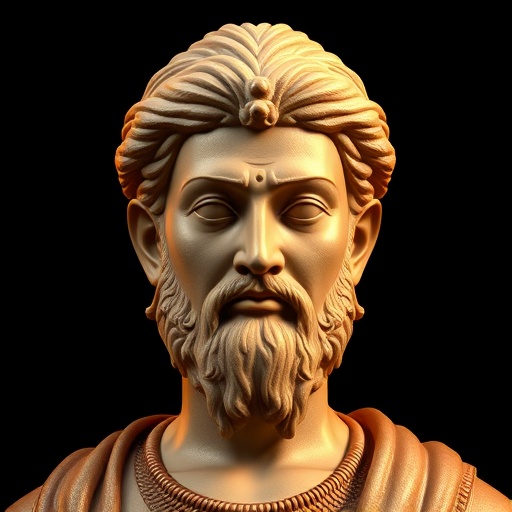
Mahavira — "The soul is the only thing that is blissful; everything else is sorrowful."
The soul is the only thing that is blissful; everything else is sorrowful.
The soul is the only thing that is blissful; everything else is sorrowful.
Click any product to generate a realistic preview. Up to 3 at a time.
* Initial load can take up to 90 seconds — revising the preview in another color is nearly instant.
"Look at the world with the eyes of a friend."
"The senses are the enemies of the soul."
"The soul is the only reality; everything else is transient."
"The ignorant, who are attached to the world, suffer from misery and pain."
"A wise man should abstain from killing any living being."
24th and last Tirthankara of Jainism, whose teachings of strict ahimsa (non-violence), aparigraha (non-attachment), and karma reshaped ancient Indian religion. Closely associated with The Buddha (near-contemporary moral revolutionary, also reacting against Vedic ritualism). For an intellectual contrast, see Vedic Brahmanical ritual sacrifice, the animal-sacrifice-centered Vedic religion of his era — Mahavira's ahimsa demanded total non-violence, including not eating root vegetables that kill the plant — a maximum-distance ethical move from the Vedic priestly tradition that ritually sacrificed cattle and horses. The two cleanest poles of ancient Indian religious ethics.
Found in 1 providers: deepseek
1 source checked
Bliss belongs exclusively to the soul — the inner self free from attachment. Every external thing — wealth, pleasure, relationships, status — inevitably brings suffering because it is impermanent and binds us through craving and aversion. True happiness cannot be found outside; it is the soul's natural condition when liberated from material entanglement. The path to joy runs inward, not outward, stripping away what we wrongly believe will satisfy us.
Mahavira was born a Kshatriya prince in 599 BCE but at 30 renounced all wealth, family, and even clothing to pursue liberation. After 12 years of extreme asceticism, he achieved omniscience (kevala jnana). He taught that the soul (jiva) is inherently pure but entangled in karma through attachment to worldly things. This quote is not abstract philosophy for Mahavira — it is the exact conviction that drove every choice of his life.
Mahavira lived during the 6th–5th century BCE in northeastern India's Gangetic plain, a period of intense religious questioning called the Shramana movement. Vedic Brahminism dominated with expensive rituals, caste hierarchy, and priestly intermediaries. The merchant class thrived but felt spiritually unfulfilled. Mahavira's radical claim — that bliss is internal and independent of ritual, caste, or wealth — directly challenged Brahminical orthodoxy and the growing materialism of his prosperous contemporaries.
AI-generated insights based on extensive research and information for context. Factual errors? Email [email protected].
Your cart is empty