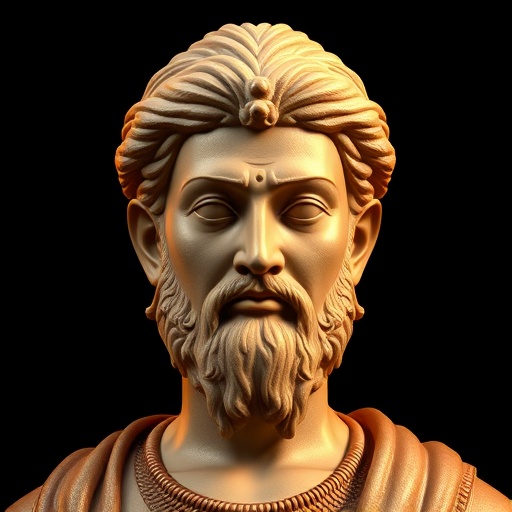
Mahavira — "The senses are the enemies of the soul."
The senses are the enemies of the soul.
The senses are the enemies of the soul.
Click any product to generate a realistic preview. Up to 3 at a time.
* Initial load can take up to 90 seconds — revising the preview in another color is nearly instant.
"The path to liberation is difficult, but it is the only path to true happiness."
"The soul is the master of its own destiny."
"As a great warrior is not afraid of a battle, so should a monk not be afraid of death."
"A man should wander about treating all creatures as he himself would be treated."
"All living beings desire happiness and despise misery."
24th and last Tirthankara of Jainism, whose teachings of strict ahimsa (non-violence), aparigraha (non-attachment), and karma reshaped ancient Indian religion. Closely associated with The Buddha (near-contemporary moral revolutionary, also reacting against Vedic ritualism). For an intellectual contrast, see Vedic Brahmanical ritual sacrifice, the animal-sacrifice-centered Vedic religion of his era — Mahavira's ahimsa demanded total non-violence, including not eating root vegetables that kill the plant — a maximum-distance ethical move from the Vedic priestly tradition that ritually sacrificed cattle and horses. The two cleanest poles of ancient Indian religious ethics.
Found in 1 providers: grok
1 source checked
Our five senses pull us toward craving, aversion, and attachment to the physical world. Every time we chase pleasure or flee discomfort, we bind ourselves more tightly to material existence and accumulate karma. True freedom requires mastering sensory impulses rather than obeying them — treating sight, sound, taste, touch, and smell as distractions that keep the soul trapped in cycles of suffering and rebirth instead of moving toward liberation.
Mahavira lived this principle literally. For twelve years he practiced extreme asceticism — pulling out his own hair, fasting for months, standing motionless in scorching heat and freezing cold, renouncing clothing and possessions entirely. He did not swat insects that bit him. His entire path to kevala jnana, omniscient liberation, was built on systematically refusing every sensory comfort until no craving remained. The quote is autobiography as much as doctrine.
In 6th-century BCE India, Vedic religion used sensory ritual — fire offerings, soma drink, music, elaborate feasts — to honor gods and secure worldly blessings. Mahavira rejected this framework entirely alongside contemporaries like Buddha. The rising merchant and kshatriya classes were questioning Brahminical authority. Declaring the senses enemies was a direct cultural provocation: spiritual merit came not from pleasuring gods with offerings but from denying the self every sensory indulgence.
AI-generated insights based on extensive research and information for context. Factual errors? Email [email protected].
Your cart is empty