Isaac Newton — "To every action there is always opposed an equal reaction."
To every action there is always opposed an equal reaction.
To every action there is always opposed an equal reaction.
Click any product to generate a realistic preview. Up to 3 at a time.
* Initial load can take up to 90 seconds — revising the preview in another color is nearly instant.
"I consider my experiments as a kind of play."
"I have not been able to discover the cause of those properties of gravity from phenomena, and I frame no hypotheses."
"Every body continues in its state of rest, or of uniform motion in a right line, unless it is compelled to change that state by forces impressed upon it."
"The wonderful arrangement and harmony of the cosmos could only have emerged from the plan of an omniscient and omnipotent Being."
"God is the same God, always and everywhere. He is omnipresent not virtually only, but also substantially; for virtue cannot subsist without substance."
Found in 1 providers: deepseek
1 source checked
When any force acts on something, that something pushes back with exactly the same strength in the opposite direction. Push a wall and the wall pushes back on you equally. This isn't metaphor — it is physical reality. Rockets fly because exhaust pushed downward produces an equal upward push on the craft. Every physical interaction involves paired forces: you cannot exert a force on anything without receiving an identical force in return.
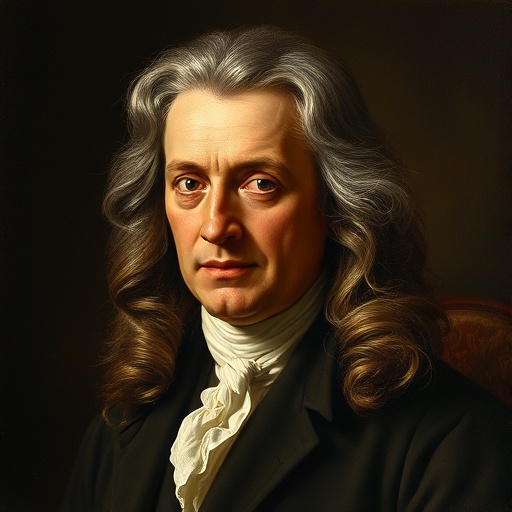
Newton formalized this as his Third Law in Principia Mathematica (1687), his masterwork unifying terrestrial and celestial mechanics. His character was defined by relentless precision and belief that nature obeys exact, universal rules without exception. His gravity insight itself embodied this principle: Earth pulls the Moon, but the Moon pulls Earth back with equal force. He spent over two decades at Cambridge developing precisely this kind of symmetric, quantifiable framework for understanding the physical world.
Newton published during the Scientific Revolution's peak, when Aristotelian physics — dominant for two thousand years — was finally being dismantled. Descartes had proposed a mechanical universe but lacked mathematical rigor. Galileo challenged motion dogma but died without a unified theory. The 1680s saw fierce competition among European natural philosophers to explain planetary orbits. Newton's Third Law, embedded in the Principia, provided the first mathematically complete mechanics, replacing centuries of speculation with equations that predicted reality with unprecedented accuracy.
AI-generated insights based on extensive research and information for context. Factual errors? Email [email protected].
Your cart is empty