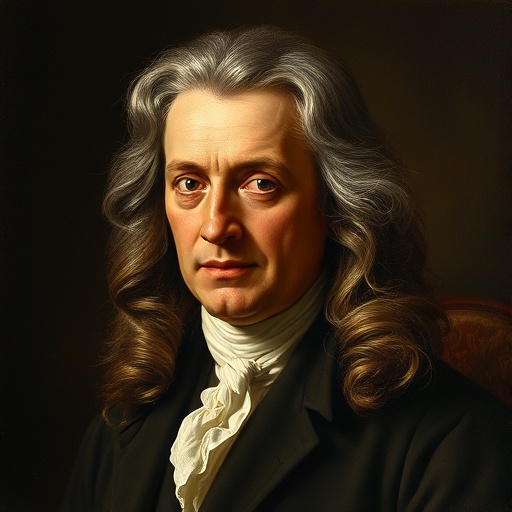
Isaac Newton — "I have not been able to discover the cause of those properties of gravity from p…"
I have not been able to discover the cause of those properties of gravity from phenomena, and I frame no hypotheses.
I have not been able to discover the cause of those properties of gravity from phenomena, and I frame no hypotheses.
Click any product to generate a realistic preview. Up to 3 at a time.
* Initial load can take up to 90 seconds — revising the preview in another color is nearly instant.
"I built my first telescope with my own hands."
"Truth is ever to be found in simplicity, and not in the multiplicity and confusion of things."
"My powers are ordinary. Only my application brings me success."
"Nature is pleased with simplicity."
"If I have done the public any service, it is due to my patient thought."
Found in 1 providers: grok
1 source checked
Newton is saying he can describe gravity's mathematical behavior with precision — how it varies with mass and distance — but cannot explain what gravity fundamentally is or why it exists. Rather than invent an untestable explanation, he refuses to speculate. 'I frame no hypotheses' is deliberate scientific restraint: only claims testable against real observation belong in science. Description without explanation is legitimate; invented mechanisms are not.
Newton spent decades deriving laws that predicted planetary orbits with astonishing accuracy, yet privately agonized over gravity's mechanism — action at a distance through empty space struck him as physically absurd. He invested equal years in alchemy and biblical prophecy, showing he was no stranger to speculation. But in formal science he drew a hard line. This quote captures his defining trait: intellectual honesty that separated what he could prove from what he merely imagined.
The 17th-century Scientific Revolution ignited fierce debate over method. Descartes proposed mechanical vortices — invented hypothetical fluids — to explain planetary motion. Newton's rival Leibniz attacked him for introducing occult action at a distance, a force with no physical carrier. The Royal Society's empiricist culture demanded evidence over speculation. Newton's declaration was a direct methodological strike: mathematical laws grounded in observation were sufficient; inventing hidden mechanisms was philosophy, not science.
AI-generated insights based on extensive research and information for context. Factual errors? Email [email protected].
Your cart is empty