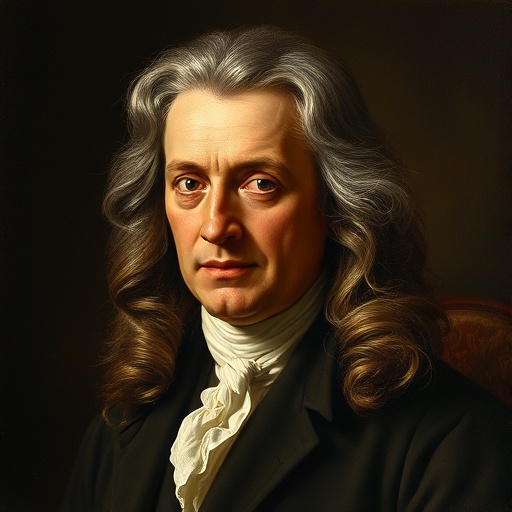
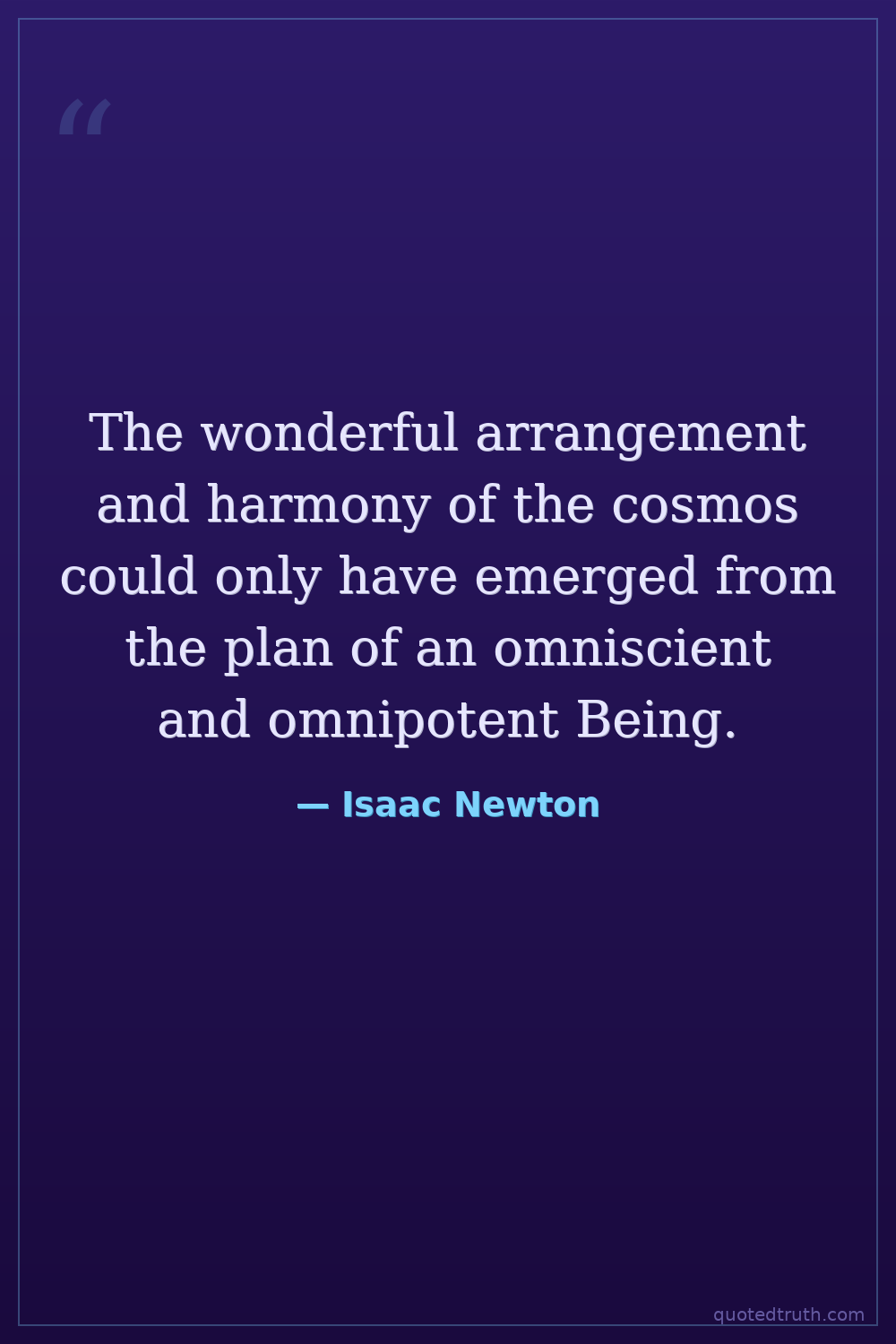
Isaac Newton — "The wonderful arrangement and harmony of the cosmos could only have emerged from…"
The wonderful arrangement and harmony of the cosmos could only have emerged from the plan of an omniscient and omnipotent Being.
The wonderful arrangement and harmony of the cosmos could only have emerged from the plan of an omniscient and omnipotent Being.
Click any product to generate a realistic preview. Up to 3 at a time.
* Initial load can take up to 90 seconds — revising the preview in another color is nearly instant.
"The true way of considering a thing is by its causes."
"The best and safest method of philosophizing seems to be, first to inquire diligently into the properties of things, and to establish those properties by experiments, and then to proceed more slowly t…"
"I have studied these things – you have not."
"Truth is the offspring of silence and meditation."
"Hypotheses non fingo. (I frame no hypotheses.)"
Found in 1 providers: grok
1 source checked
The universe's mathematical precision — planetary orbits, gravitational constants, physical laws — is too perfectly ordered to arise by chance. An all-knowing, all-powerful God must have designed it. This is the classical argument from design: the cosmos functions like an intricate machine whose elegant harmony points directly to an intelligent architect rather than random, undirected natural processes producing such coherent structure.
Newton devoted as much effort to theology as to physics, writing over a million words on biblical prophecy. His Principia Mathematica framed gravitational law as evidence of divine craftsmanship. He believed God actively maintained planetary orbits and rejected purely mechanical explanations that left no room for a Creator. Despite revolutionizing science, he saw himself primarily as uncovering God's rational design — his discoveries were acts of theological inquiry.
The Scientific Revolution of the 17th century dismantled medieval cosmology — Copernicus, Galileo, and Kepler repositioned Earth as just one planet among many. Descartes proposed a purely mechanical universe, alarming theologians who feared science would displace God. Newton's era intensely debated whether natural laws made divine intervention unnecessary. His assertion that cosmic harmony proved divine authorship was a deliberate counter to growing materialist philosophy threatening to sever science from religion.
AI-generated insights based on extensive research and information for context. Factual errors? Email [email protected].
Your cart is empty