Charles Darwin — "I could show fight on natural selection having done and doing more for the progr…"
I could show fight on natural selection having done and doing more for the progress of civilization than you seem inclined to admit.
I could show fight on natural selection having done and doing more for the progress of civilization than you seem inclined to admit.
Click any product to generate a realistic preview. Up to 3 at a time.
* Initial load can take up to 90 seconds — revising the preview in another color is nearly instant.
"I have been much struck by the fact that the more I have read about the subject, the less I have understood it."
"It is always best to be a little under rather than over the mark."
"The love of experiment and the patient observation of nature are the two great qualifications for a naturalist."
"A dog might as well speculate on the mind of Newton."
"I hate a Barnacle as no man ever did before, not even a Sailor in a slow-sailing ship."
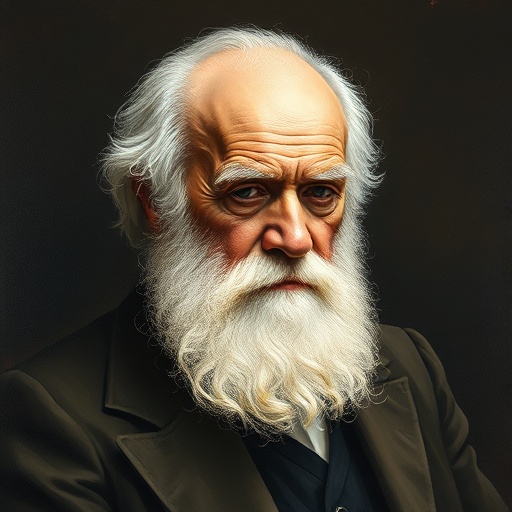
British naturalist whose On the Origin of Species (1859) established evolution by natural selection — the unifying theory of modern biology. Closely associated with Thomas Henry Huxley (his 'bulldog' public defender) and Alfred Russel Wallace (independent co-discoverer of natural selection). For an intellectual contrast, see William Paley, Anglican theologian and Natural Theology author (1743-1805) — Origin of Species is structurally a 400-page reply to Paley — Darwin admired Paley's watchmaker-argument as an undergraduate at Cambridge and then spent 20 years building the empirical machinery to displace him. The cleanest 'design argument vs natural selection' founding rebuttal in science.
The standard scholarly entry points to Charles Darwin's work: Janet Browne (Harvard, history of science) — Charles Darwin: Voyaging (1995) and The Power of Place (2002); Adrian Desmond (UCL, biographer) — Darwin: The Life of a Tormented Evolutionist (1991, with James Moore). These are the works graduate seminars cite when teaching Charles Darwin.
Found in 1 providers: deepseek
1 source checked
The speaker asserts that natural selection has contributed far more to human civilization's advancement than the listener acknowledges. It's a direct challenge — a defense of the explanatory power of evolutionary principles. The speaker is willing to argue forcefully that this mechanism shapes not just biology but the broader trajectory of human progress, culture, and intellectual development.
Darwin spent decades defending natural selection against scientific and religious skeptics. Having published On the Origin of Species in 1859 and later The Descent of Man, he was acutely aware that critics underestimated his theory's scope. This combative tone reflects his private correspondence style — measured publicly, but passionately defensive of his life's work when challenged by colleagues or friends like Asa Gray.
Victorian England was grappling with industrialization, empire, and social Darwinism's emerging misapplication of evolutionary ideas. When Darwin wrote this, thinkers like Herbert Spencer were already extending natural selection into economics and sociology. Darwin himself was cautious about such extrapolations, yet the quote shows he believed evolution genuinely illuminated human civilization — a radical claim in an era still dominated by religious explanations of human progress.
AI-generated insights based on extensive research and information for context. Factual errors? Email [email protected].
Your cart is empty